A 7 color LED light therapy chart is the mode table printed on the box of a consumer LED face mask, listing each light setting alongside a wavelength in nanometres and a claimed skin benefit. Seven modes is now the common configuration, typically red, blue, green, yellow, purple, cyan and white.
The chart below sets out what each mode is, in physical terms, and separates the modes with a published clinical literature behind them from those without one. The two are not the same set. Peer-reviewed reviews of LED therapy in dermatology examine four wavelength bands; the seven-colour format is a product-design convention rather than a clinical one.
Contents
The 7 color LED light therapy chart
| Mode | Wavelength | Commonly claimed for | Evidence base |
|---|---|---|---|
| Red | 630–760 nm | Fine lines, collagen, scar healing, skin rejuvenation | Established |
| Blue | 400–470 nm | Acne, bacterial control, barrier repair | Established |
| Yellow / amber | 570–590 nm | Melasma, photoaging, redness | Studied |
| Green | 520–530 nm | Pigmentation, uneven tone | Limited |
| Purple | not a wavelength | “Combined red and blue benefits” | Blend of two modes |
| Cyan | 490–520 nm, or a blend | Calming, hydration, “cell energy” | No clinical base |
| White | broad, phosphor-converted | “Full spectrum”, deep regeneration | No clinical base |
| Near-infrared | 760–1200 nm | Deeper tissue, wound healing, pigmentation | Established |
Near-infrared is included because it appears on higher-specification masks and has a substantial literature, despite being invisible and therefore absent from most seven-colour charts. Wavelength bands as used in a 2025 review of LED therapy in cosmetic dermatology.[1]
Colour and wavelength
Visible light occupies roughly 380 to 700 nanometres. Colour is a direct function of wavelength, which means a stated colour and a stated nanometre figure must agree with each other:
| Approximate range | Perceived colour |
|---|---|
| 400–450 nm | Violet |
| 450–490 nm | Blue |
| 490–520 nm | Cyan |
| 520–560 nm | Green |
| 560–590 nm | Yellow |
| 590–620 nm | Orange |
| 620–700 nm | Red |
| 700–1200 nm | Near-infrared (not visible) |
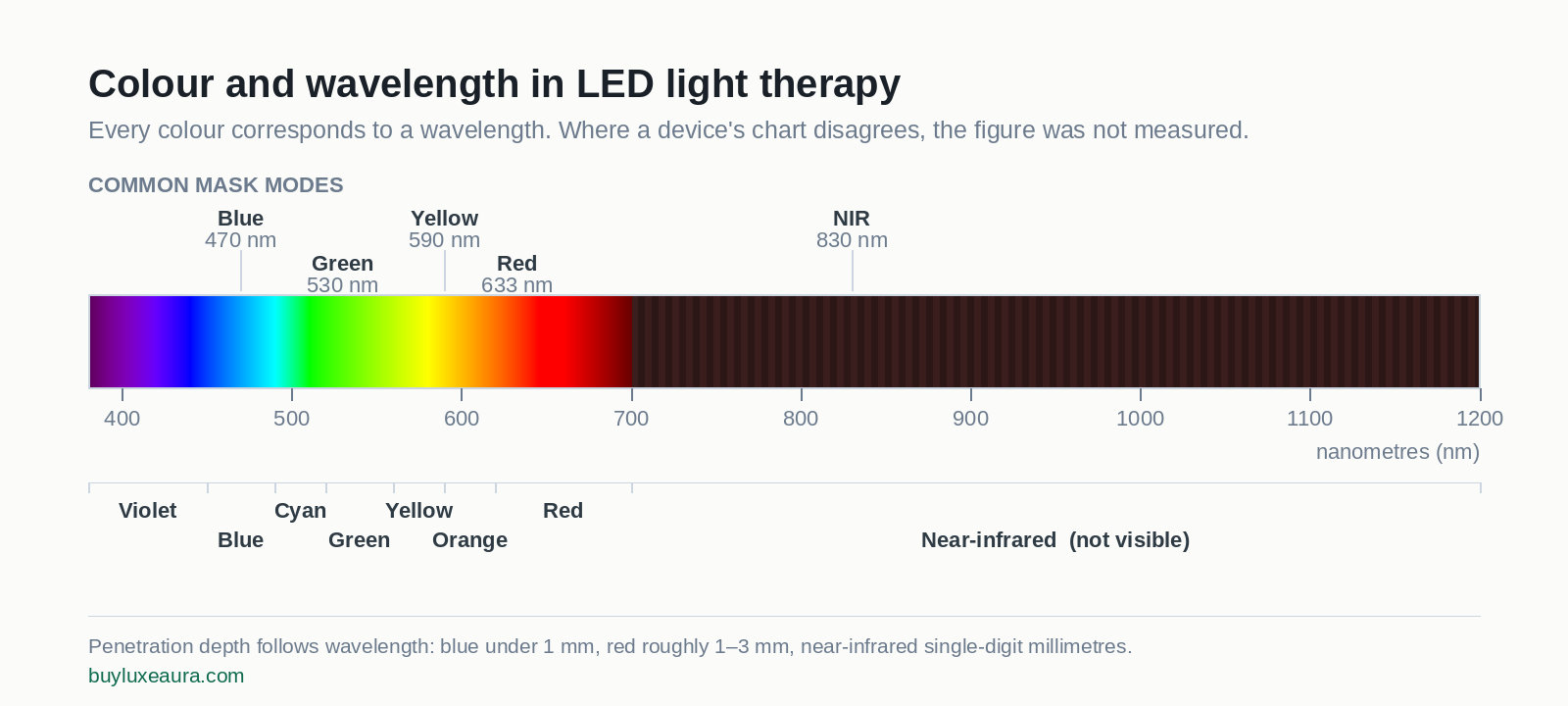
This makes some chart entries checkable at a glance. A mode labelled purple with a wavelength of 600 nm is describing orange light. A mode labelled violet at 550 nm is describing green. Where a chart’s colour and figure disagree, the figure was not measured.
Penetration depth also follows wavelength, and it is short. Blue light is absorbed within the epidermis, under a millimetre. Red reaches roughly one to three millimetres. Near-infrared travels furthest of the wavelengths used here and is still measured in single-digit millimetres. Charts advertising penetration in centimetres or inches are describing something that does not occur.
What the evidence supports
A 2025 review of LED therapy in cosmetic dermatology assessed four wavelength bands: blue, yellow, red and near-infrared.[1] The selection is itself informative — these are the bands with enough published work to review.
Red, 630–760 nm
The most studied band for cosmetic use. Red light penetrates more deeply than blue and is associated with collagen synthesis, scar healing and skin rejuvenation. It is the wavelength most consumer masks are built around, and the one most home-use clinical trials examine, often paired with near-infrared.
Blue, 400–470 nm
Targets acne through an antibacterial mechanism, and has been associated with skin barrier repair. Blue is the second best-supported band and the reason acne-focused masks exist as a separate category.
Yellow, 570–590 nm
Studied for melasma and photoaging, with a proposed mechanism of suppressing melanogenesis. The literature is smaller than for red or blue but the band is represented in peer-reviewed work.
Near-infrared, 760–1200 nm
Invisible, and therefore absent from most seven-colour charts, but well represented in the research — pigmentary disorders, skin aging and wound healing. Masks that include it typically pair 830 nm with 633 nm red.
Green, 520–530 nm
Green sits outside the four bands the 2025 review assessed. A broader review covering violet, blue, green, yellow, red and near-infrared includes it, but the evidence for cosmetic pigmentation outcomes is thinner than for the bands above.[2] Green modes are common on consumer masks; the claims attached to them run ahead of the published work.
The evidence for green, including one controlled 2025 study and the separate and stronger migraine literature, is set out in what does green light therapy do.
The two most studied bands are compared directly in red vs blue light therapy.
Combination
Combining wavelengths is reported to improve outcomes for acne, photoaging and wound repair.[1] This is the substantive argument for a multi-mode mask — though it applies to combining bands that each have support, not to increasing the number of modes for its own sake.
Blended modes: purple and cyan
Purple is not produced by a purple LED. There is no diode emitting a wavelength the eye reads as purple in the way there is for red or blue. What a mask calls purple is red and blue diodes illuminated together, which the eye integrates as magenta.
This has a practical consequence. A blended mode cannot be assigned a single nanometre figure, because two wavelengths are present. When a chart lists “purple, 600 nm”, the number is decorative — and 600 nm is orange in any case.
Cyan is treated inconsistently. Some masks produce it with a genuine emitter around 490–520 nm; others blend blue and green. Either way, cyan does not correspond to a recognised band in the dermatological literature, and claims attached to it — hydration, cell energy, calming — are not drawn from clinical work.
None of this makes a blended mode harmful. Running red and blue diodes at once delivers red and blue light, both of which have support. The objection is to the labelling: a blend is presented as an eighth wavelength with its own mechanism, and it is neither.
White light
White LEDs are generally not broad-spectrum emitters. The standard construction is a blue diode coated in a phosphor that re-emits part of the blue output across longer wavelengths, producing a spectrum with a blue peak and a broad, uneven remainder.
A white mode therefore delivers an unspecified mixture, dominated by blue, at an unspecified irradiance per band. Claims of “full spectrum” treatment or “deep regeneration” do not follow from this, and no clinical literature examines white LED light as a dermatological treatment in its own right.
Why dose matters more than colour
A colour chart describes which wavelengths a device can emit. It says nothing about how much light arrives at the skin, which is what determines whether anything happens.
Delivered dose is expressed in joules per square centimetre:
Dose (J/cm²) = Irradiance (mW/cm²) × Time (s) ÷ 1000
Two masks can list identical wavelengths and identical session lengths and deliver doses that differ by an order of magnitude, because irradiance is the variable neither the chart nor the instruction leaflet mentions. At 30 mW/cm², a ten-minute session delivers about 18 J/cm². At 3 mW/cm², the same session delivers under 2 J/cm².
Irradiance is not a required disclosure, and practice varies. Some manufacturers publish a measured figure at a stated distance; many publish none. A seven-colour chart with no irradiance figure describes the device’s vocabulary without describing whether it can speak loudly enough to be heard.
Converting an output figure into a session length is set out in how long to do red light therapy on face.
Verifying a device’s regulatory status is a related check and takes about two minutes — the procedure is set out in the list of FDA cleared LED face masks.
How to read a specific mask’s chart
The chart on a given product can be checked in a few minutes without any equipment. Four tests, in order of how much they tell you.
- Do the colours and the numbers agree? Compare each stated nanometre figure against the ranges in the table above. A disagreement means the figure was copied rather than measured, which puts the rest of the specification sheet in question.
- Is an irradiance figure published? Look for mW/cm², ideally with a stated measuring distance. Its absence is the single most informative thing about a device, because it is the number that determines whether a session delivers a meaningful dose.
- Is near-infrared included? An 830 nm mode will not appear on a seven-colour chart, because it is invisible. Its presence indicates a manufacturer building around the literature rather than around the number of settings.
- How many modes rest on nothing? Count the modes with a corresponding band in the reviewed literature — red, blue, yellow, near-infrared — against those without. A seven-mode mask often has three or four modes doing the work and the rest making up the number.
More settings is not better. A mask with two well-specified wavelengths at a published irradiance is a more defensible purchase than one with seven modes and no output figure, and the chart on the box is designed to make the opposite impression.
Limits of the research
The literature on visible-light therapy is genuinely mixed, and a chart of colours and benefits presents it as more settled than it is.
A 2025 analysis in PLOS One examined methodological reporting across LED dermatology studies and found that trials report widely varying irradiances, wavelengths and outcome measures — to the point that comparing results between studies, or synthesising them into an overall efficacy estimate, is obstructed.[3]
Three consequences follow for anyone reading a mode chart:
- A wavelength having “evidence behind it” does not mean any device emitting that wavelength produces the studied effect, since the dose in the study may bear no relation to the dose the device delivers.
- Clinical studies frequently use professional equipment at irradiances a consumer mask does not reach.
- An absence of published work on a mode — cyan, white — is an absence of evidence rather than evidence of absence. It does mean the benefit claimed for it was not derived from a study.
Safety
LED masks in this category emit no ultraviolet and generate little heat, and the wavelengths involved are non-ionising.
One nuance is worth recording. A review of skin responses across the visible spectrum found that violet (approximately 400–420 nm) and blue (approximately 420–470 nm) light show antimicrobial and anti-keloid activity, but may also induce oxidative stress.[2] Blue light is the band most often described as uniformly benign in marketing material, and the picture is more mixed than that.
Eye protection is the other standard precaution. Most masks include shielding or eye cut-outs; where they do not, the manufacturer’s guidance on keeping the eyes closed is worth following rather than treating as boilerplate.
Photosensitising medication — including some antibiotics, retinoids and St John’s wort — is a reason to check with a clinician before using any light-based device.
Frequently asked questions
What do the 7 colors in LED light therapy do?
Red supports collagen and skin rejuvenation, blue targets acne through an antibacterial mechanism, and yellow has been studied for melasma and photoaging. Green has a thinner evidence base for pigmentation. Purple and cyan are usually two sets of diodes running together rather than distinct wavelengths, and white is a blue diode with a phosphor coating. Only four wavelength bands — blue, yellow, red and near-infrared — are assessed in peer-reviewed reviews of LED therapy in cosmetic dermatology.
Is purple light a real wavelength in LED masks?
No. There is no purple diode in the sense there is a red or blue one. A purple mode is red and blue diodes illuminated together, which the eye reads as magenta. This means a purple mode cannot be assigned a single nanometre figure, because two wavelengths are present. A chart listing purple at 600 nm is describing orange light, which is a separate error.
Which LED light color is most effective?
Red, at roughly 630 to 760 nm, has the largest published literature for cosmetic use, usually paired with near-infrared around 830 nm. Blue is the best-supported band for acne. Which is more effective depends on the concern being treated, and in both cases the delivered dose matters more than the colour: a wavelength with strong evidence behind it produces nothing if the device emits too little of it.
How deep does LED light penetrate skin?
Not far. Blue light is absorbed within the epidermis, under a millimetre. Red reaches roughly one to three millimetres. Near-infrared travels furthest of the wavelengths used in these devices and is still measured in single-digit millimetres. Any chart advertising penetration in centimetres or inches is describing something that does not physically occur.
Does a mask with more colors work better?
Not by itself. Combining wavelengths is reported to improve outcomes for acne, photoaging and wound repair, but that applies to combining bands that each have support, not to increasing the number of settings. A mask with two well-specified wavelengths and a published irradiance figure is more defensible than one with seven modes and no output figure.
What does white light do in an LED face mask?
White LEDs are typically a blue diode coated in a phosphor that re-emits part of the blue output across longer wavelengths, producing an uneven spectrum with a blue peak. A white mode therefore delivers an unspecified mixture at an unspecified irradiance per band. No clinical literature examines white LED light as a dermatological treatment in its own right, so claims of full-spectrum treatment or deep regeneration are not drawn from published work.
References
- Guo et al. (2025). The Application of Light Emitting Diode (LED) in Cosmetic Dermatology. Photodermatology, Photoimmunology & Photomedicine.
- Biological and Therapeutic Responses of Human Skin to Different Wavelengths of Light: A Comprehensive Review. PubMed Central.
- Methodological issues in visible LED therapy dermatological research and reporting. PLOS One, 2025.
Method. Wavelength bands and clinical associations are taken from the peer-reviewed reviews cited above. Colour-to-wavelength ranges are standard values for the visible spectrum. Where a mode has no corresponding band in the reviewed literature, that is stated rather than inferred from marketing material. No device was tested for this article.