The red vs blue light therapy question is usually asked as though one has to win. It does not work that way. The two wavelengths treat different conditions, by different mechanisms, at different depths in the skin. Choosing between them is less like choosing between two moisturisers and more like choosing between an antibiotic and a collagen supplement.
Both are the best-evidenced bands in consumer light therapy. Which one is right depends entirely on what is being treated — and for some people the answer is both.
Blue
400–470 nm
- Acne
- Bacterial control
- Skin barrier repair
Absorbed in the epidermis, under 1 mm
Red
630–760 nm
- Fine lines, collagen
- Scar healing
- Skin rejuvenation
Reaches roughly 1–3 mm
Contents
What blue light does
Blue occupies roughly 400 to 470 nanometres and is the acne wavelength. A 2025 review of LED therapy in cosmetic dermatology associates the blue band with acne vulgaris, antibacterial activity and skin barrier repair.[1]
The mechanism is bacterial rather than cosmetic. Blue light acts on the bacteria implicated in inflammatory acne, which is why it is the one band in consumer light therapy that treats a condition rather than an appearance. It is also why blue is a separate product category: acne-focused devices exist because blue does something red does not.
The caveat that marketing leaves out
Blue is routinely presented as uniformly gentle. A comprehensive review of skin responses across the visible spectrum gives a more mixed picture: violet at roughly 400 to 420 nanometres and blue at roughly 420 to 470 show antimicrobial and anti-keloid activity, but may also induce oxidative stress.[2]
This is not a reason to avoid blue light. It is a reason to follow the manufacturer’s stated session length rather than treating longer exposure as more thorough, and to be sceptical of any device recommending extended daily blue sessions.
What red light does
Red occupies roughly 630 to 760 nanometres and is the most studied band in cosmetic light therapy. The same 2025 review associates it with scar healing, hair growth and skin rejuvenation, and notes that it penetrates more deeply than blue.[1]
Red is a cosmetic wavelength rather than a therapeutic one in the medical sense. It is not killing anything or treating a diagnosed condition. The proposed mechanism concerns cellular energy production, and the outcomes measured in studies are things like fine lines, texture and healing rate.
Near-infrared travels with it
Most well-specified masks pair red with near-infrared at 830 to 850 nanometres. Near-infrared is invisible, penetrates further than any visible wavelength used in these devices, and is associated in the literature with pigmentary disorders, skin aging and wound healing.[1]
Because it cannot be seen, budget masks routinely omit it — there is no visible cue that a buyer is missing anything. When comparing devices, the presence of a near-infrared mode says more about the manufacturer than the number of visible colours does.
Depth is the reason they differ
Almost everything that separates red from blue follows from one physical fact: penetration depth tracks wavelength. Longer wavelengths travel further into tissue.
| Band | Wavelength | Approximate depth | What sits there |
|---|---|---|---|
| Blue | 400–470 nm | Under 1 mm | Epidermis, sebaceous ducts, surface bacteria |
| Red | 630–760 nm | 1–3 mm | Dermis, fibroblasts, collagen structure |
| Near-infrared | 760–1200 nm | Single-digit mm | Deeper dermal tissue |
Blue stops at the layer where acne bacteria live. Red reaches the layer where collagen is produced. Neither is reaching further than that, and any claim of penetration measured in centimetres or inches is describing something that does not happen at these wavelengths.
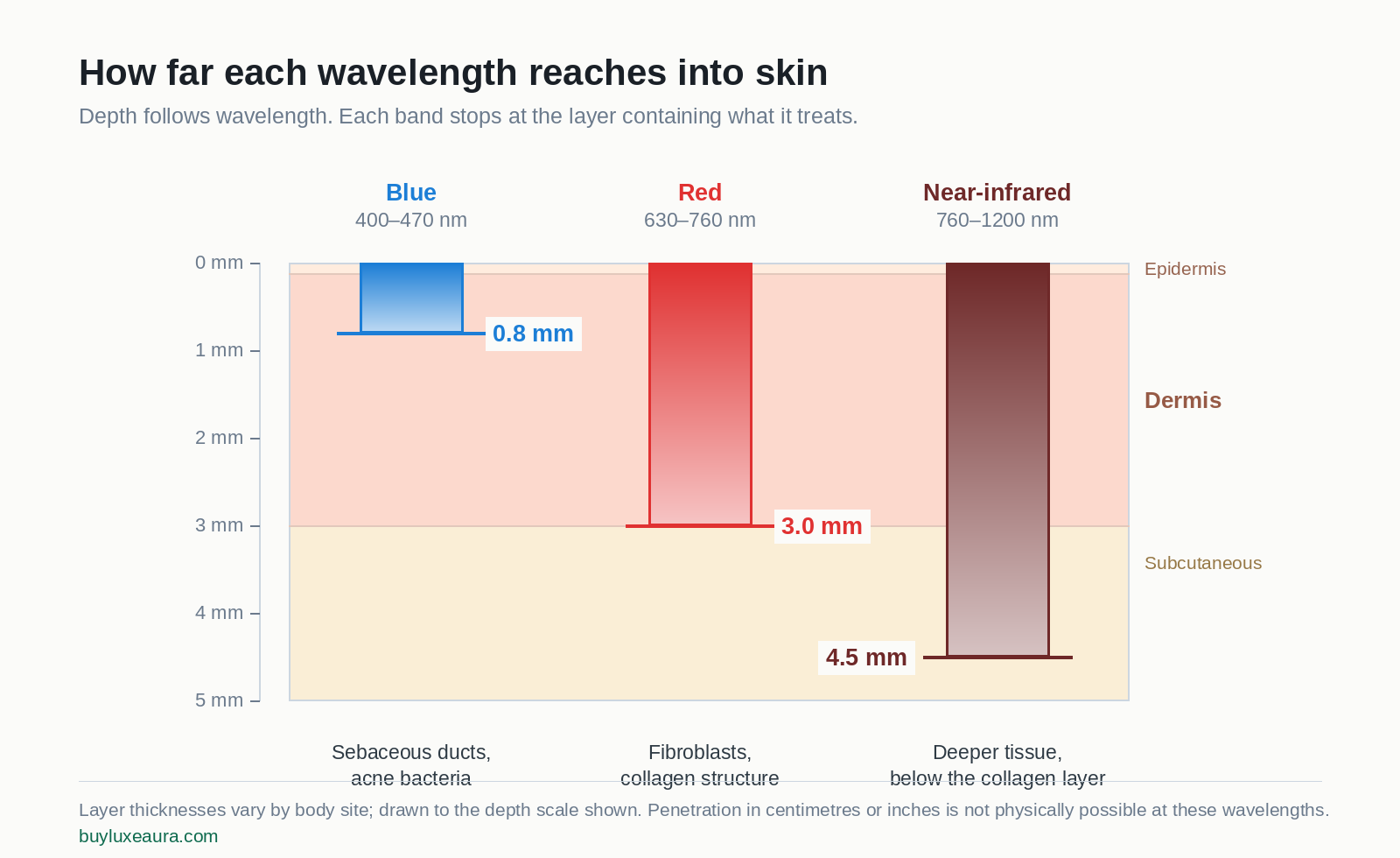
This also settles a common misconception. Blue is not a weaker version of red, and red is not a deeper version of blue. They stop at different depths because they are different wavelengths, and the thing each one treats happens to live at the depth it reaches.
Can you use both?
Yes, and the research supports it. The 2025 review reports that combining wavelengths enhances outcomes for acne, photoaging and wound repair.[1] This is the substantive argument for a multi-mode mask.
Two qualifications matter.
Combining bands that each have support
The finding concerns combining wavelengths with an evidence base, not increasing the number of settings for its own sake. Red plus blue plus near-infrared is a defensible combination. Red plus blue plus four decorative modes is the same combination with marketing attached — as the 7 color LED light therapy chart sets out mode by mode.
Simultaneous or separate
Masks handle this differently. Some offer a combined mode running red and blue diodes at once; others expect separate sessions. Published protocols vary, and the studies underlying combination findings do not use a single standard approach — part of a broader problem in this literature, where trials report widely differing irradiances, wavelengths and outcome measures, which obstructs direct comparison between them.[3]
In practice, following the manual is more defensible than improvising. Where a device offers both a combined mode and separate modes, there is no published basis for preferring one over the other, and doubling up by running both sequentially delivers twice the dose rather than twice the benefit.
Which to choose
Start from the concern rather than from the device.
| If the concern is | The relevant band | Note |
|---|---|---|
| Active inflammatory acne | Blue | The one band treating a condition rather than an appearance |
| Fine lines, firmness | Red + near-infrared | Largest evidence base; expect months, not sessions |
| Acne scarring | Red | Scar healing, not bacterial control |
| Both acne and aging | Both | The case for a combination device |
| Pigmentation, melasma | Neither, primarily | Yellow and green are the studied bands; see what does green light therapy do |
A mask offering only red is not deficient if acne is not the concern. A mask offering only blue is not a rejuvenation device. The number of modes is a poor proxy for whether a device suits a particular person.
Three mistakes this comparison produces
Using blue for acne marks
The brown or red marks left behind after a spot clears are not acne. They are post-inflammatory pigmentation or lingering vascular change, and the bacteria blue light acts on are no longer involved. Blue does nothing for them. Red is the band associated with healing, and pigmentation has its own studied wavelengths.
Expecting blue to be the stronger option
Blue sits at the high-energy end of the visible spectrum, which invites the assumption that it is the more powerful setting. Photon energy and clinical effect are different things. Blue is absorbed sooner precisely because of that energy, which is why it never reaches the dermis at all.
Buying red-only for active acne, or blue-only for lines
Each is buying a device for the layer the problem is not in. This is the single most common mismatch in the category, and it is produced by product pages that lead with mode count rather than with what each mode is for.
Dose decides whether either works
The red vs blue light therapy question is the wrong first question for most buyers. Whether a device delivers a meaningful dose of either matters more than which colours it lists.
Dose (J/cm²) = Irradiance (mW/cm²) × Time (s) ÷ 1000
Published guidance places the useful per-session dose in the region of 5 to 9 J/cm², with a broader effective window of roughly 3 to 15.[4] Light therapy follows a biphasic dose response: below the window nothing happens, and beyond it more light adds nothing.
Two consequences:
- A wavelength with strong evidence produces nothing at insufficient output. A mask emitting genuine 633 nm red at 3 mW/cm² delivers under 2 J/cm² in ten minutes — below the threshold. The colour is right and the dose is not.
- Session length is not a free variable. At high irradiance, research-range doses arrive in a minute or two. Running a mask longer because it feels more thorough moves past the window rather than further into it.
Which is why the question to ask any manufacturer is the irradiance in mW/cm² and the distance at which it was measured — ahead of the colour count, and ahead of the LED count. Checking a device’s regulatory status takes about the same time, and the procedure is set out in the list of FDA cleared LED face masks.
Red vs blue light therapy, in short
Blue is antibacterial, works in the epidermis, and treats acne. It has the clearest therapeutic target of any consumer wavelength, and the one documented caveat — possible oxidative stress — is a reason to follow stated session lengths rather than exceed them.
Red is cosmetic, works in the dermis, and is the most studied band for lines, texture and healing. Paired with near-infrared it is what a well-specified rejuvenation mask is built around.
Together they are reported to outperform either alone for acne, photoaging and wound repair — which is the honest argument for a multi-mode device, and applies to combining researched bands rather than to owning seven of them.
This article summarises published research and is not medical advice. Persistent or severe acne, and any condition being treated with photosensitising medication such as certain antibiotics or retinoids, should be discussed with a clinician before using a light-based device.
Frequently asked questions
Which is better, red or blue light therapy?
Neither, because they treat different things. Blue at 400 to 470 nm is antibacterial and targets acne. Red at 630 to 760 nm penetrates deeper and is associated with collagen, scar healing and skin rejuvenation. Blue works in the epidermis, red reaches the dermis. Which is right depends on the concern, and for someone dealing with both acne and ageing the answer is often both.
Can you use red and blue light therapy together?
Yes. A 2025 review of LED therapy in cosmetic dermatology reports that combining wavelengths improves outcomes for acne, photoaging and wound repair. That finding applies to combining bands that each have evidence behind them, not to increasing the number of settings. Whether to run them simultaneously or in separate sessions is not settled by the literature, so following the device manual is the more defensible approach.
Does blue light therapy help acne scars?
Not the marks left after a spot clears. Those are post-inflammatory pigmentation or lingering vascular change, and the bacteria blue light acts on are no longer involved. Red is the band associated with scar healing, and pigmentation has separate studied wavelengths in the yellow and green range. Blue treats active inflammatory acne, not its aftermath.
How deep does red light penetrate compared to blue?
Blue is absorbed within the epidermis, under a millimetre, which is where acne bacteria sit. Red reaches roughly one to three millimetres, into the dermis where collagen is produced. Near-infrared at 760 to 1200 nm travels furthest of the wavelengths used in these devices and is still measured in single-digit millimetres. Depth follows wavelength, and this is why the two bands treat different things.
Is blue light therapy safe for daily use?
Blue light in these devices emits no ultraviolet and generates little heat. One caveat is worth knowing: a comprehensive review of skin responses across the visible spectrum found that violet and blue light show antimicrobial and anti-keloid activity but may also induce oxidative stress. That is a reason to follow the stated session length rather than exceed it, not a reason to avoid blue. Anyone using photosensitising medication should check with a clinician first.
Do I need near-infrared as well as red?
Most well-specified masks pair red at 633 nm with near-infrared at 830 to 850 nm, and near-infrared is associated in the literature with pigmentary disorders, skin ageing and wound healing. Because it is invisible, budget masks routinely leave it out — there is no visible cue that anything is missing. Its presence tells you more about a manufacturer than the number of visible colour modes does.
References
- Guo et al. (2025). The Application of Light Emitting Diode (LED) in Cosmetic Dermatology. Photodermatology, Photoimmunology & Photomedicine.
- Biological and Therapeutic Responses of Human Skin to Different Wavelengths of Light: A Comprehensive Review. PubMed Central.
- Methodological issues in visible LED therapy dermatological research and reporting. PLOS One, 2025.
- Light Therapy Insiders. Light therapy mask dosing guide — per-session fluence ranges.
How this article was researched
Wavelength bands and their clinical associations are taken from the peer-reviewed sources cited above. Penetration depths are standard values for the visible and near-infrared spectrum. Dose figures are arithmetic applied to published fluence guidance rather than measurements taken here. No device was tested for this article and no cosmetic outcome is claimed for any product. Where the underlying literature is inconsistent — as it is on combination protocols — that inconsistency is reported rather than resolved.