Ask what does green light therapy do and you get two answers that have almost nothing to do with each other. One concerns pigmentation and is the reason green appears on LED face masks. The other concerns migraine, has considerably stronger research behind it, and works through a mechanism a face mask cannot use.
Separating them matters, because the marketing for the first frequently borrows credibility from the second.
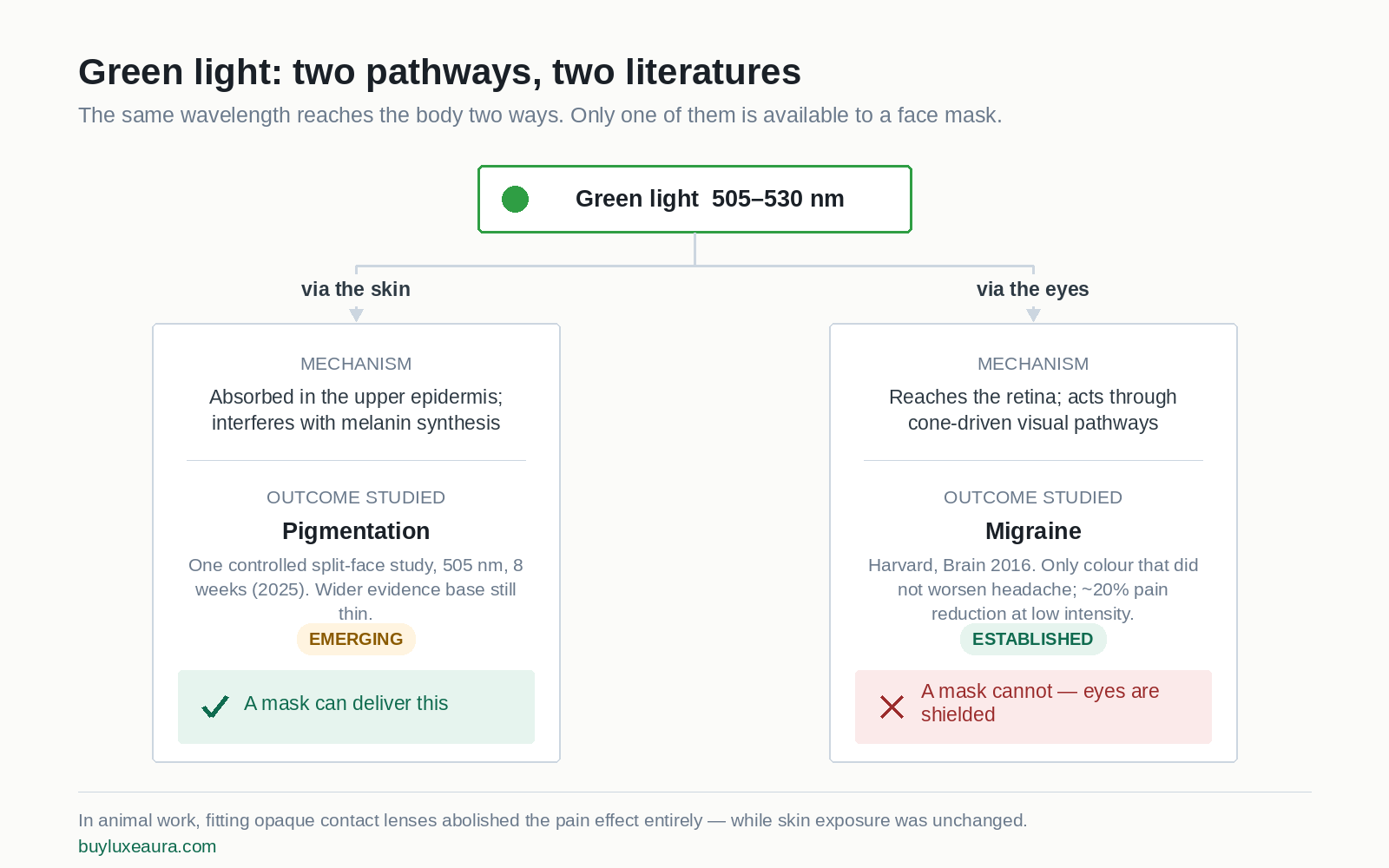
On skin
One controlled human study in 2025 found measurable pigmentation improvement. The broader evidence base remains thin, and much of what circulates comes from green lasers, which are a different instrument entirely.
Emerging
On migraine
Harvard research published in Brain found green was the only colour that did not worsen headache, and at low intensity reduced it. The effect travels through the eyes, not the skin.
Established
Contents
Green light on skin
The claim attached to a green mode on a face mask is nearly always pigmentation: dark spots, melasma, uneven tone. The proposed mechanism is interference with melanin synthesis rather than destruction of pigment already present.
The 2025 study
The most substantial evidence is a study published in Acta Dermato-Venereologica examining a 505 nm green LED. It combined cellular work — B16 melanoma cells and a three-dimensional skin model — with a human intervention study using a split-face design.[1]
In the human arm, one side of the face received green LED irradiation and the other did not. After eight weeks the treated side showed statistically significant improvement across every measured parameter: melanin levels and skin brightness at p < 0.001, skin colour index at p < 0.05, and number of spots at p < 0.01. Comparing results at four and eight weeks, longer irradiation produced greater improvement.
That is a real result with an internal control, and it is more than green light had behind it two years ago. The paper also notes that while several LED wavelengths have been reported to inhibit melanin production, the effects of green specifically remained largely unexplored — which is a fair summary of where the field stood.
An erratum to the paper was published in March 2026. Anyone relying on the specific figures should read the corrected version rather than the original.
What one study does and does not settle
A single split-face study is a starting point, not a consensus. Set against it:
- Independent analyses continue to describe the clinical evidence for green LED in hyperpigmentation as limited, with the position that no peer-reviewed work conclusively demonstrates standalone green LED devices significantly reducing hyperpigmentation in living skin.[2]
- Some researchers have described green LED for melasma as a myth, on the grounds that the idea was imported from a different technology.
- The 2025 study used 505 nm. Consumer masks commonly advertise 520 to 530 nm. Results at one wavelength do not automatically transfer to another.
The honest position is that green light on skin has moved from “no controlled evidence” to “one controlled study with positive results”, which is progress rather than proof.
The laser confusion
Much of the confidence around green light for pigmentation comes from somewhere it does not belong. Dermatologists do use green light for pigment and vascular lesions — at 532 nm, delivered by laser.
A laser and an LED are not comparable instruments. A 532 nm laser delivers concentrated, high-energy pulses capable of physically fragmenting pigment or coagulating a blood vessel. An LED emits low-power, diffuse light intended to modulate cell behaviour. They share a colour and almost nothing else.[2]
When a product page says green light is “clinically proven” for pigmentation, it is worth asking which instrument the clinical work used. The answer is frequently a laser, and the transfer of that evidence to a $99 mask is not one the research supports.
Green light and migraine
The strongest evidence for green light concerns pain, and it emerged from an observation about photophobia — the light sensitivity that accompanies migraine.
The Harvard study
Researchers at Beth Israel Deaconess Medical Center and Harvard Medical School exposed patients experiencing acute migraine attacks to blue, green, amber and red light at varying intensities, and asked them to report any change in headache. The work was published in Brain in 2016.[3]
Of 69 participants, 41 completed the study. At high light intensity — comparable to a well-lit office — close to 80 per cent reported their headache intensifying under every colour except green. Green did not worsen it. At low intensity, green light reduced headache pain by approximately 20 per cent.[4]
Using electroretinography and visual evoked potentials in patients, alongside multi-electrode recordings in rats, the researchers traced the effect to cone-driven retinal pathways — the colour-sensing apparatus of the eye.[3]
Subsequent work
A 2023 open-label study by the same group, using daily headache diaries collected online, examined narrow-band green light across headache, photophobia, sleep and anxiety.[5] Separate trials at other institutions have examined narrowband green LED exposure over longer periods for migraine frequency.
This is a smaller and younger literature than the one behind red light for skin, and much of it is open-label rather than blinded — which is difficult to avoid, since participants can see what colour the light is. But it is considerably more developed than the evidence for green on skin, and it comes from headache medicine rather than from cosmetics.
Why the migraine effect needs your eyes
This is the part that determines whether any of it applies to a face mask, and it is consistently left out of product copy.
The migraine effect is not a skin effect. It is a visual one, mediated by cone photoreceptors in the retina. The clearest demonstration comes from animal work in which rats exposed to 525 nm green LED showed significantly increased withdrawal latency to a noxious thermal stimulus — an antinociceptive effect that persisted for days after exposure ended. When the animals wore opaque contact lenses, the effect disappeared entirely.[6]
Blocking the light from reaching the retina abolished the benefit, even though the skin exposure was unchanged. The pathway runs through the eye.
The devices used in migraine research reflect this. They are lamps and bulbs, narrowband at roughly 520 to 525 nm, used in a room for one to two hours while the person goes about their day with their eyes open. Some include a shroud so the user does not look directly at the source.
What this means for LED masks
An LED face mask is worn against the skin, with eyes closed or behind cut-outs, for ten to twenty minutes. Every element of that is wrong for the migraine mechanism:
| Migraine research setup | LED face mask | |
|---|---|---|
| Route | Through the eyes, retina | Against the skin, eyes shielded |
| Duration | 1–2 hours daily | 10–20 minutes |
| Wavelength | Narrowband ~520–525 nm | ~520–530 nm, bandwidth rarely stated |
| Device | Room lamp or bulb | Face-contact panel |
A green mode on a mask is not a migraine treatment, and a mask should not be bought as one. Where a product page invokes green light research without specifying that the research concerns vision rather than skin, it is borrowing credibility from a study that does not apply to it.
The reverse also holds: the 2025 pigmentation study is not evidence for anything to do with headache. Two separate literatures, two separate mechanisms, one shared colour.
This article describes published research and is not medical advice. Migraine is a medical condition; anyone considering light therapy for it should discuss it with a clinician rather than buying a cosmetic device.
What to reasonably expect from a green mode
Green sits in a specific position among the wavelengths on a consumer mask, and it helps to place it honestly.
| Wavelength | Target | Evidence for cosmetic use |
|---|---|---|
| Red, 630–660 nm | Collagen, fine lines | Established |
| Blue, 415–470 nm | Acne bacteria | Established |
| Near-infrared, 830–850 nm | Deeper tissue, healing | Established |
| Yellow, 570–590 nm | Melasma, redness | Studied |
| Green, 505–530 nm | Pigmentation, tone | One controlled study |
Three practical points follow.
Green is shallow, which is the point
Green light penetrates less deeply than red or near-infrared, reaching the upper epidermis. For pigmentation that is arguably an advantage rather than a limitation, since visible discolouration sits in exactly those layers. It also means green cannot do what red does, and a mask offering green instead of red is not offering a substitute.
How the two best-evidenced bands differ from each other, and how deep each one reaches, is set out in red vs blue light therapy.
Timescales are long
The 2025 study measured at four and eight weeks, with the eight-week results stronger. Any pigmentation protocol is a matter of months rather than sessions, and results are gradual. A product promising visible change in days is not describing anything the research supports.
Dose still governs everything
As with every wavelength, output determines whether a session delivers anything:
Dose (J/cm²) = Irradiance (mW/cm²) × Time (s) ÷ 1000
A mask with a green mode and no published irradiance figure has told you which colour it can emit and nothing about how much. The relevant question to ask any manufacturer is the output in mW/cm² and the distance at which it was measured. The 7 color LED light therapy chart sets out the same test across every mode, and the list of FDA cleared LED face masks covers how to check a device’s regulatory status.
So what does green light therapy do?
Two things, in two different places, and the distinction is the whole answer:
- On skin, green light appears to interfere with melanin synthesis. One controlled split-face study in 2025 found measurable improvement in pigmentation over eight weeks. That is one study, at one wavelength, and the wider evidence base remains thin.
- Through the eyes, narrowband green light at roughly 520 nm is the one colour that does not worsen migraine, and at low intensity reduces headache pain. That finding is well established, comes from headache medicine, and depends on light reaching the retina.
A green mode on a face mask can only participate in the first. It is a reasonable inclusion alongside red and blue, a poor reason to choose one mask over another, and no substitute for sunscreen.
Sun protection outranks the device
Melasma and post-inflammatory pigmentation are driven substantially by ultraviolet exposure. No light-therapy device competes with daily sunscreen for pigmentation, and any device used without it is working against the cause. This is the least exciting sentence in this article and the most reliably supported.
Frequently asked questions
What does green light therapy do for your skin?
The proposed mechanism is interference with melanin synthesis rather than removal of pigment already present, which is why it is marketed for dark spots and uneven tone. One controlled split-face study published in 2025 found significant improvement in melanin levels, brightness and spot count after eight weeks using a 505 nm green LED. Independent analyses still describe the overall evidence base as limited, so treat it as promising rather than proven.
Does green light therapy help migraines?
Research from Harvard Medical School published in Brain in 2016 found that green was the only colour that did not intensify migraine headache, and that at low intensity it reduced pain by around 20 per cent. The effect was traced to cone-driven pathways in the retina. This is a stronger evidence base than green light has for skin, but it is a medical question and belongs with a clinician rather than with a cosmetic device purchase.
Can an LED face mask help with migraines?
No. The migraine effect works through the eyes, not the skin. In animal work, fitting opaque contact lenses abolished the benefit entirely even though skin exposure was unchanged. A face mask is worn against the skin with the eyes closed or shielded, for ten to twenty minutes, whereas the research devices are room lamps used for one to two hours with eyes open. A green mode on a mask is not a migraine treatment.
Is green light therapy the same as a green laser treatment?
No, and conflating them is where much of the confidence in green LED comes from. Dermatologists use 532 nm green lasers for pigment and vascular lesions, delivering concentrated high-energy pulses that can physically fragment pigment. An LED emits low-power diffuse light intended to modulate cell behaviour. They share a colour and very little else, and evidence from one does not transfer to the other.
How long does green light therapy take to work on pigmentation?
Months rather than sessions. The 2025 study measured at four and eight weeks and found the eight-week results stronger than the four-week ones, with longer irradiation producing greater improvement. Any product promising visible change in days is not describing something the research supports. Daily sun protection matters more for pigmentation than any light device.
Is green light better than red light?
They do different things and are not substitutes. Red at 630 to 660 nm penetrates more deeply and has the largest evidence base for collagen and fine lines. Green penetrates only the upper epidermis, which suits surface pigmentation but means it cannot do what red does. A mask offering green instead of red is not offering an alternative to it.
References
- Mima Y. et al. Inhibitory Effect of 505 nm Green Light Emitting Diode on Melanin Synthesis in Cellular Experiments and a Human Intervention Study. Acta Dermato-Venereologica. Erratum published March 2026.
- Luyors. Green vs yellow LED light therapy for melasma — on the limits of green LED evidence and the laser-versus-LED distinction.
- Noseda R., Burstein R. et al. Migraine photophobia originating in cone-driven retinal pathways. Brain, 2016.
- Harvard Medical School. Green light migraine relief — summary of the 2016 findings.
- Lipton R.B., Melo-Carrillo A., Burstein R. et al. Narrow band green light effects on headache, photophobia, sleep, and anxiety among migraine patients. Frontiers in Neurology, 2023.
- Long-lasting antinociceptive effects of green light in acute and chronic pain in rats — the study in which opaque contact lenses abolished the effect, cited in the photophobia literature.
How this article was researched
Claims here are taken from the peer-reviewed sources cited above and from Harvard Medical School’s own summary of its 2016 study. Where a finding rests on a single study, that is stated. Where independent analyses disagree with a positive result, the disagreement is reported rather than resolved. No device was tested for this article, and no cosmetic or clinical outcome is claimed for any product. Statistical values are as reported in the underlying papers. This is a summary of published research, not medical advice.