The question of how long to do red light therapy on face has no single correct answer, and any article giving one without asking about your device is guessing. Ten minutes on one mask can deliver seven times the dose of ten minutes on another.
What determines the answer is a figure most manufacturers do not publish: irradiance, the light output measured in milliwatts per square centimetre. With it, session length is arithmetic. Without it, the number in the manual is a manufacturer’s preference rather than a protocol.
This page sets out what the research actually uses, how to convert that into a session length for your own device, and what to do if your mask publishes no output figure at all.
The short answer
| If your device outputs | Session length for 5–9 J/cm² | A 10-minute session delivers |
|---|---|---|
| 3 mW/cm² | 28–50 minutes | 1.8 J/cm² — below the window |
| 10 mW/cm² | 8–15 minutes | 6 J/cm² — in range |
| 20 mW/cm² | 4–7.5 minutes | 12 J/cm² — upper range |
| 30 mW/cm² | 3–5 minutes | 18 J/cm² — above the window |
| 50 mW/cm² | 2–3 minutes | 30 J/cm² — well above |
| 105 mW/cm² | under 1.5 minutes | 63 J/cm² — far above |
Based on a per-session window of 5 to 9 J/cm², the range most often cited for facial use. Calculated at the skin surface; see distance.
Contents
- Why “ten minutes” is not an answer
- Work out your own session length
- What the research actually uses
- The biphasic curve, and its own caveat
- Why some trials use 480 J/cm²
- How often, and for how many weeks
- Distance, and why the figure may not apply
- Six things that change the number
- If your device publishes no irradiance
- A practical protocol
- Frequently asked questions
- References
Why “ten minutes” is not an answer
Ten minutes is the most common instruction printed on LED face masks, and it is the length most reviews repeat. It became a convention rather than a finding.
Consider two masks, both emitting genuine 633 nm red light, both instructing ten minutes. One outputs 10 mW/cm², the other 105. The first delivers 6 J/cm² per session — squarely in the range used for facial work. The second delivers 63 J/cm², roughly seven times the upper end of that window.
Same instruction, same wavelength, same duration. Doses an order of magnitude apart. The instruction cannot be right for both.
A session length is only meaningful in combination with an output figure. A device that publishes one without the other has given you half an equation.
This is why the first question about any mask is its irradiance, not its LED count or its number of colour modes. The devices that publish both a clearance number and an output figure are a short list, and it is short for this reason.
Work out your own session length
Delivered dose, called fluence, is the total energy reaching a given area over a session:
Dose (J/cm²) = Irradiance (mW/cm²) × Time (seconds) ÷ 1000
Rearranged to solve for time:
Time (seconds) = Target dose (J/cm²) × 1000 ÷ Irradiance (mW/cm²)
Enter your device’s published irradiance below. If the product page does not state one, that is itself the answer to a different question — see what to do if your device publishes no irradiance.
For 5 J/cm²
—
For 9 J/cm²
—
A 10-minute session gives
—
The calculator applies the formula above to a target of 5 to 9 J/cm². It uses the figure you enter and cannot verify it; a manufacturer's stated irradiance is a claim until independently measured.
What the research actually uses
Two ranges appear repeatedly in guidance for facial work, and they overlap rather than agree.
| Range | Context | Frequency |
|---|---|---|
| 4–10 J/cm² | General photobiomodulation window for 600–1000 nm, cited as the therapeutic band[1] | 5–15 minutes, a few sessions weekly |
| 5–20 J/cm² | Facial anti-ageing specifically, at 630–660 nm[2] | 3–5 sessions weekly, 8–12 weeks |
The practical reading is that anything between roughly 5 and 15 J/cm² per session sits inside what published work has used for skin. Below about 3, there is no reason to expect an effect. Above about 20, there is no published reason to expect more of one.
The most cited controlled demonstration for red light and skin rejuvenation remains Wunsch and Matuschka's 2014 trial in Photomedicine and Laser Surgery.[2] It is worth knowing that the evidence base for this specific application rests on a small number of trials rather than a large literature.
The biphasic curve, and its own caveat
Photobiomodulation follows a biphasic dose response, sometimes called a hormetic curve. Low to moderate exposure stimulates cellular activity; beyond a point, additional exposure produces no further benefit and may generate excessive reactive oxygen species or stall the response being sought.[1]
This is the origin of the standard advice that more is not better, and as a rule of thumb it holds. But there is a complication that rarely gets mentioned alongside it.
The curve was established in cell culture
In a dish, the absorbed dose is roughly the same as the delivered dose. In real skin it is not. Much of the light is scattered or absorbed in the upper layers before reaching the deeper dermis, so the effective in-tissue dose at any given depth is always lower than the fluence measured at the surface.[2]
Two things follow. First, it is part of why clinical results have consistently lagged the optimism of laboratory mechanistic studies. Second, it means surface fluence and absorbed dose are not the same quantity, and the numbers in this article — like the numbers in every consumer guide — are surface figures.
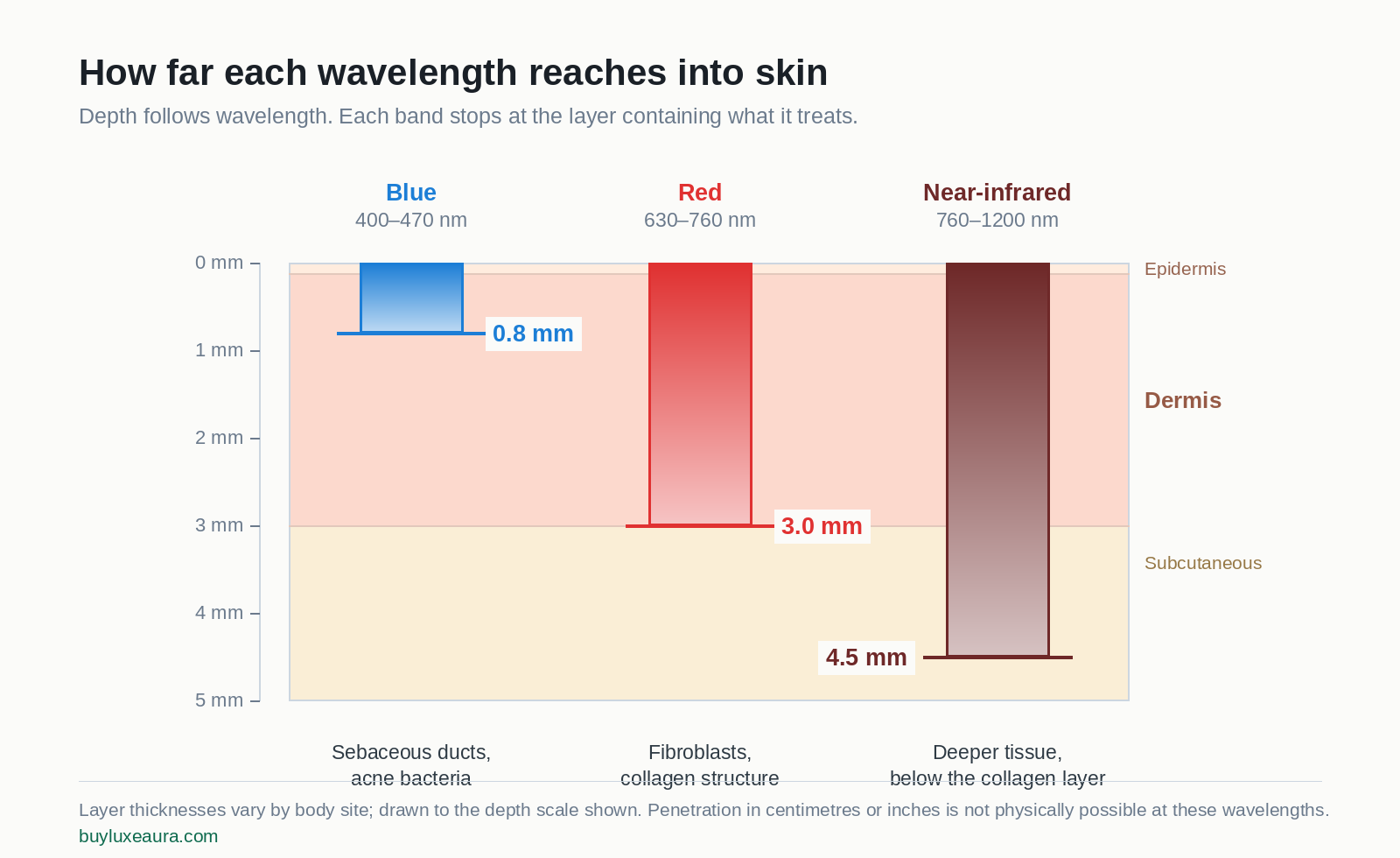
The honest position is that the window given here is a reasonable operating range drawn from published work, not a precise biological threshold. Treating 9 J/cm² as a cliff edge overstates what is known.
Why some trials use 480 J/cm²
Anyone reading the clinical literature will encounter fluences far above anything discussed here, and it is worth explaining rather than ignoring.
Two phase I trials, STARS 1 and STARS 2, examined red light at fluences from 160 up to 480 J/cm² on normal forearm skin across 115 subjects combined, establishing safety and tolerability at those levels. A follow-on phase II study applied 160, 320 and 480 J/cm² to surgical incision sites, three times weekly for three weeks, with sessions running 30 to 90 minutes.[3]
Three things separate that from a mask on a bathroom shelf:
- A different indication. Those trials concern post-surgical scarring and fibrosis, not cosmetic rejuvenation. The biology being targeted is different.
- Supervision. Sessions were administered in a clinical setting with temperature-matched controls.
- Adverse events occurred. Reported effects included erythema, hyperpigmentation and localised blistering — described as mild and resolving without permanent consequence, but present.[3]
So the existence of high-fluence research is not permission to run a mask for an hour. It demonstrates that the ceiling is condition-specific and that exceeding the cosmetic window has observable effects, which is the opposite of a reason to do it casually.
How often, and for how many weeks
Frequency is more consistent across sources than duration.
- Three to five sessions a week is the range cited for facial use.[1][2] Daily is not obviously better, and rest days appear in most published protocols.
- Eight to twelve weeks before clinical photography shows reliable change.[2] This is the figure most worth internalising, because it is the one marketing most consistently contradicts.
A device promising visible results in days is not describing anything the research supports. Nothing in the literature on red light and skin produces a visible change on that timescale, at any dose.
Distance, and why the figure may not apply
Irradiance falls off with distance from the source. A figure measured at the diode face can be several times the figure at the treatment surface, and both are legitimately called "irradiance".
This is why a published number is worth much more when it states a measuring distance, and why two manufacturers' figures are not comparable unless both do. Most consumer-facing irradiance figures are not measured the way clinical research measures them.[4]
A flexible silicone mask sits close to the skin, which narrows the gap considerably compared with a panel used at 15 or 30 centimetres. But "close" is not zero, and a figure without a stated distance carries an unknown margin.
Practically: if your device states an irradiance with no distance, treat the calculated session length as an upper bound rather than a target, and start shorter.
Six things that change the number
The arithmetic above assumes a single figure applies uniformly. Several factors mean it does not, and they are worth knowing before treating a calculated session length as exact.
Skin tone
Melanin absorbs light. More heavily pigmented skin absorbs a greater proportion of incident light in the upper layers, which means less reaches the depth being targeted. Published guidance notes that dosing varies by skin type.[1] It also means the surface fluence and the effective dose diverge more, not less, at the same setting — one more reason surface figures are approximations.
Whether the mask covers everything at once
A face mask treats the whole face simultaneously. A panel treats a zone at a time, and the protocol is usually stated per area. When comparing a mask's session length against a figure quoted for a panel, check whether the panel figure is per area — total session time can differ substantially while the dose per area is identical.
How flush the mask sits
Irradiance falls off with distance, and a flexible mask does not contact every part of the face equally. Areas that bridge across the cheekbones or nose sit further from the diodes than areas in contact. The dose across the face is a range rather than a single value, and the parts that matter most for a given concern are not necessarily the parts closest to the light.
What is on the skin
Light has to reach skin to act on it. Makeup, mineral sunscreen and thick occlusive products all sit between the source and the target. Most guidance suggests a clean face, which is less a ritual than a practical matter of not blocking the light being paid for.
Which wavelength is running
The 5 to 9 J/cm² window discussed here is for red at 630 to 660 nm. Blue light targets a different depth and a different mechanism, and combined modes mean the dose is split across two bands rather than delivered entirely as red. On a device running red and blue simultaneously, the red dose is lower than the same session length on red alone. How the two differ is set out in red vs blue light therapy.
Pulsed versus continuous output
Some devices pulse rather than emitting continuously. Where that is the case, the average irradiance over a session is lower than the peak figure, and a published number may refer to either. This is a further reason a figure without stated measurement conditions carries an unknown margin, and a reason to start at the shorter end when the conditions are not given.
None of these invalidate the calculation. They mean a calculated session length is a well-grounded starting point rather than a prescription, and that erring shorter costs less than erring longer.
If your device publishes no irradiance
This is the common case, and it deserves a direct answer rather than a shrug.
Look harder first
Check the manual, the packaging and the FAQ page as well as the product description. Search the brand's site for "mW" rather than "irradiance" — the figure sometimes appears in a specification table without being highlighted. If a model code is printed on the device, search that too.
Ask
Email the manufacturer and ask two questions: the irradiance in mW/cm², and the distance at which it was measured. Brands that have the figure generally supply it. A brand that cannot or will not answer has told you something useful.
Then follow the manual
Absent a figure, the manufacturer's stated session length is the only instruction you have, and deviating from it has no informed basis in either direction. Running longer to compensate for a suspected low output is a guess that could equally overshoot.
The realistic position is that an unpublished irradiance makes the question unanswerable for that device. That is not a satisfying conclusion, but it is the accurate one, and it is worth weighing before buying rather than after.
A practical protocol
Assembled from the ranges above, for facial use with a device that publishes its output.
| Approach | Why | |
|---|---|---|
| Starting point | Begin at the shorter end — around 5 J/cm² — for the first two weeks | Conservative starts appear across published home-use guidance; tolerance varies by skin type |
| Target dose | 5–9 J/cm² per session, extending toward 15 only with a well-documented device | The overlap of the ranges cited for facial work |
| Frequency | 3–5 sessions a week, not daily | Matches published protocols; rest days are standard |
| Duration | 8–12 weeks before judging results | The interval at which controlled trials photograph change |
| Consistency | Short regular sessions over long infrequent ones | Cumulative exposure, not session length, is what protocols vary |
| If unsure | Follow the manual | Improvising against an unknown output is not a protocol |
Signs to stop and reassess
Persistent redness lasting well beyond a session, unusual dryness or irritation, or headaches and eye strain after use are all reasons to shorten sessions or stop and consult a clinician. These are listed in general guidance on overexposure rather than being specific to any device.[1]
How long to do red light therapy on face, in short
If your device publishes an irradiance figure, the session length is arithmetic: aim for 5 to 9 joules per square centimetre, which at 30 mW/cm² is three to five minutes and at 10 mW/cm² is eight to fifteen. Three to five times a week. Judge results at eight to twelve weeks, not sooner.
If it does not publish one, the honest answer is that nobody can tell you — including the brand, in any verifiable way. Follow the manual, and treat the missing figure as information about the device rather than a detail to look past.
This article summarises published research and is not medical advice. Anyone with a skin condition under treatment, or taking photosensitising medication such as certain antibiotics, retinoids or St John's wort, should speak to a clinician before using a light-based device.
Frequently asked questions
How long should I use a red light therapy mask on my face?
It depends on your device's irradiance. Aim for 5 to 9 J/cm² per session. At 30 mW/cm² that is roughly three to five minutes; at 10 mW/cm² it is eight to fifteen. A ten-minute session on a 105 mW/cm² device delivers about 63 J/cm², far beyond the range used for facial work. If your device publishes no output figure, follow the manual, because no calculation is possible without it.
Is 10 minutes of red light therapy enough for the face?
Only at certain output levels. Ten minutes at 10 mW/cm² delivers 6 J/cm², which sits inside the effective range. Ten minutes at 3 mW/cm² delivers under 2 J/cm², below the threshold at which anything is expected. Ten minutes has become the standard instruction on LED masks by convention rather than by finding, and it cannot be correct for devices whose output differs by a factor of ten.
Can you overdo red light therapy on your face?
Photobiomodulation follows a biphasic dose response: beyond a point, more exposure produces no further benefit and may generate excessive reactive oxygen species. Clinical trials at very high fluences — 160 to 480 J/cm² — reported erythema, hyperpigmentation and localised blistering, all mild and resolving, but those were supervised sessions for post-surgical scarring rather than cosmetic use. Persistent redness, unusual dryness, headaches or eye strain after sessions are reasons to shorten or stop.
How often should I do red light therapy on my face?
Three to five sessions a week is the range cited across published guidance for facial use, rather than daily. Rest days appear in most protocols. Consistency over weeks matters more than the length of any individual session, since it is cumulative exposure that the protocols vary rather than session duration alone.
How long before I see results from red light therapy on my face?
Eight to twelve weeks before clinical photography shows reliable change, at three to five sessions a week. This is the figure marketing most consistently contradicts. Nothing in the published literature on red light and skin produces visible change within days, at any dose, so a product promising that is not describing a researched outcome.
Does longer mean better results with red light therapy?
No. Once a session reaches the effective window, additional time adds exposure without adding benefit, and past a point can work against the response being sought. On a high-output device the window is reached in one to two minutes, so running it for ten is not a stronger treatment — it is the same treatment plus eight minutes of surplus.
Why do masks not publish their irradiance?
Because it is not a required disclosure and it is the number most easily compared against a competitor. LED count is visible in a product photograph; irradiance is not, so it is the easier specification to omit. Some budget devices fall below 5 mW/cm², at which point session length stops being meaningful. A brand that publishes the figure, and the distance at which it was measured, has made a claim that can be checked.
Does skin tone change how long I should use it?
It changes how much of the light reaches the target depth. Melanin absorbs light, so more heavily pigmented skin absorbs a greater proportion in the upper layers and less arrives deeper. Published guidance notes that dosing varies by skin type. It is a reason to treat any calculated session length as a starting point rather than a precise prescription, and to begin at the shorter end.
References
- Ubie Health doctor's note. The biphasic dose response in red light therapy — therapeutic window and overexposure signs.
- Red light therapy dose: irradiance, joules, fluence — facial fluence ranges, the Wunsch and Matuschka 2014 trial, and the surface-versus-absorbed dose distinction.
- CURES: a dose-ranging phase II study of LED-red light for skin scarring prevention, and the STARS phase I dose-escalation protocol. PubMed Central.
- Mito Red Light. Red light therapy dosing: irradiance, joules, and measurement method — on why consumer irradiance figures are not measured as clinical research measures them.
- Light Therapy Insiders. Light therapy mask dosing guide.
How this article was researched
Dose ranges are taken from the sources cited above; where two sources give different windows, both are shown rather than averaged. All session lengths are arithmetic applied to the standard fluence formula and to a manufacturer's stated irradiance — they are calculations, not measurements. Figures are surface fluence, which is not the same as absorbed dose in tissue, and this distinction is stated in the article rather than glossed. High-fluence trial parameters are included because they appear in the literature and would otherwise mislead; they concern a different indication under clinical supervision. No device was tested for this article and no cosmetic outcome is claimed for any product. Two of the cited sources are commercial sites publishing dosing guidance; they are used for the ranges they compile and are named as such rather than presented as primary research.
Last reviewed 17 September 2026.