Searching for an FDA red light therapy mask returns dozens of devices, nearly all of which mention the FDA somewhere on the product page. Very few of them can be checked.
This page applies two tests. Both are public, both take about two minutes, and together they separate a device whose claims can be confirmed from one whose claims merely exist.
Test 1
A clearance number that resolves to this device
Not the word “FDA” in a list of certifications. A K-number — the letter K followed by six digits — that can be entered in the FDA database and returns a record covering the mask on sale.
Test 2
A published irradiance figure
Output in mW/cm². Without it, a stated session length cannot be converted into a delivered dose, so there is no way to know whether a treatment reaches the range used in research.
Of the devices examined for this site, three pass both tests or come close enough to be worth listing. That is not a shortlist chosen for brevity — it is how many were left.
Contents
Why these two tests
The regulatory test
LED masks are Class II medical devices. They are cleared through the 510(k) pathway, not approved — approval applies to Class III devices such as pacemakers. Clearance produces a number.[1]
That number is the whole point. “FDA cleared” without a number is a claim. With a number it is a record anyone can open. A brand that holds a clearance and does not publish its number has made a verifiable claim unverifiable by choice.
One complication applies across this entire category: most masks are built by contract manufacturers, and the clearance is filed under the factory’s name rather than the brand’s. A device can be legitimately covered while the brand appears nowhere in a search for its own name. The list of FDA cleared LED face masks sets out all 46 clearances currently on record and how few carry a consumer brand name.
The output test
Clearance says nothing about how much light a device emits. Delivered dose is what produces an effect:
Dose (J/cm²) = Irradiance (mW/cm²) × Time (s) ÷ 1000
Published guidance places the useful per-session dose around 5 to 9 J/cm², within a broader window of roughly 3 to 15.[2] A mask emitting genuine 633 nm red at 3 mW/cm² delivers under 2 J/cm² in ten minutes — the right wavelength at a dose below the threshold.
Working a session length out for a specific device, including a calculator, is covered in how long to do red light therapy on face.
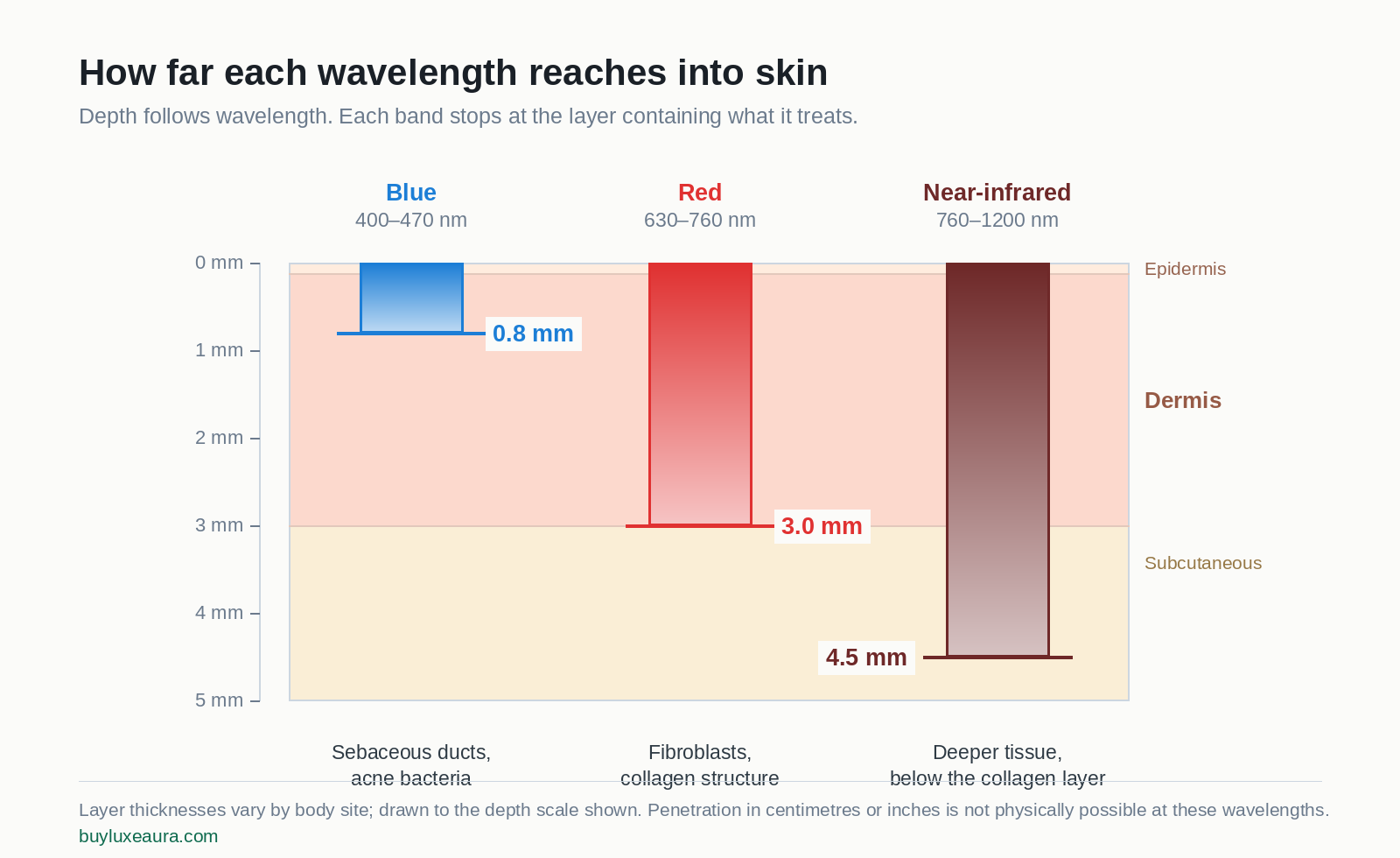
Irradiance is not a required disclosure, and most manufacturers omit it. Publishing it is a choice, and it is the most informative choice a manufacturer in this category makes.
The three that verify
Ranked by how cleanly the clearance resolves to the device on sale, not by price or specification.
CurrentBody Skin LED Mask Series 2
Strongest paper trail · around $470
| Clearance | K260715 — applicant The Beauty Tech Group Ltd, cleared 03 Jun 2026 |
| Irradiance | 30 mW/cm², stated by the manufacturer |
| Wavelengths | 633 nm red, 830 nm near-infrared, 1072 nm deep near-infrared |
| LEDs | 236 |
| Session | 10 minutes, 3–5× per week |
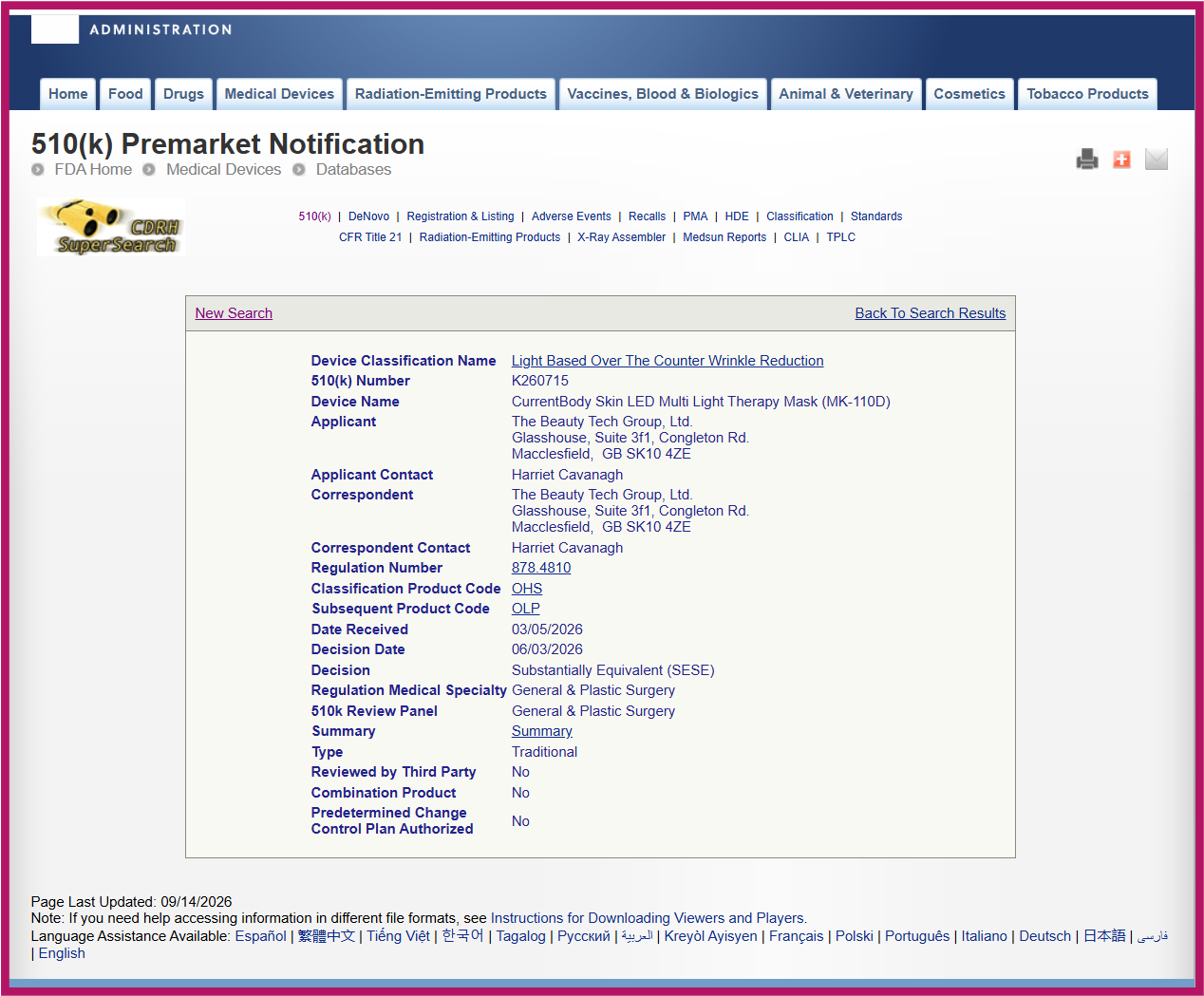
The clearance is held by the brand’s own parent company rather than by an unrelated manufacturer, which makes this the shortest chain of the three: one lookup, one record, the applicant name recognisable. It is also the only one of the three carrying a third wavelength at 1072 nm.
Worth knowing: an independent reviewer using a spectrometer measured this mask at 18.5 mW/cm² against the stated 30, and still found the ten-minute session delivered a dose within the effective range.[3] That gap is worth knowing about, and it is only knowable because a figure was published in the first place.
Suits: someone who wants the most documented option and is not constrained by price. No blue light, so not an acne device.
Omnilux Contour Face
Resolves in two databases · around $395
| Clearance | K191629 — listed as faceLITE, applicant iSMART Marketing Svcs Ltd, cleared 12 Sep 2019 |
| Irradiance | approximately 26–30 mW/cm² |
| Wavelengths | 633 nm red, 830 nm near-infrared |
| LEDs | 132 |
| Session | 10 minutes, 3–5× per week |
Searching the FDA database for Omnilux returns nothing, because the clearance is filed under a different device name. The link is established in a second FDA database: the Global Unique Device Identification Database carries a record for Omnilux Contour FACE, model TN19G, with its premarket submission number given as K191629.[4]
Three lookups rather than one, but it resolves completely — and it is a useful demonstration that a brand’s absence from a name search proves nothing on its own.
Suits: the same buyer as above, at $75 less, with two wavelengths instead of three and roughly half the diodes. The longest clinical track record of the three.
INIA GLOW Wireless
Passes the output test, partly passes the clearance test · around $100–120
| Clearance | K253833 and K252553 cover models prefixed INIA, applicant Shenzhen Jianchao Intelligent Technology |
| Irradiance | 105 mW/cm², stated — no measuring distance given |
| Wavelengths | 630 nm red, 460 nm blue, 610 nm, 850 nm near-infrared |
| LEDs | 272 |
INIA publishes an irradiance figure, which most of this category does not, and covers four wavelength bands including both blue and near-infrared. Two clearances list model numbers beginning INIA. What is missing is the link between them: the brand publishes neither a K-number nor the model code of the GLOW Wireless, so a buyer cannot establish that this particular mask is among the models covered.
On the 105 figure: that is unusually high, and without a stated measuring distance it cannot be compared with the 30 above. It also has a practical consequence — at 105 mW/cm², a research-range dose arrives in roughly one to one and a half minutes, so session length matters more here than on a lower-output device. The full working is in the INIA red light mask review.
Suits: a buyer at a quarter of the price who wants blue light as well as red, and who accepts that the clearance covers a model line rather than a confirmed device.
Side by side
| CurrentBody Series 2 | Omnilux Contour Face | INIA GLOW Wireless | |
|---|---|---|---|
| Clearance resolves | One lookupbrand’s own group | Three lookupsvia GUDID | Model line onlydevice not confirmed |
| Irradiance published | 30 mW/cm² | ≈26–30 mW/cm² | 105 mW/cm²no distance stated |
| Independently measured | Yes — 18.5 mW/cm² | Not found | Not found |
| Near-infrared | 830 + 1072 nm | 830 nm | 850 nm |
| Blue for acne | No | No | 460 nm |
| LEDs | 236 | 132 | 272 |
| Approx. price | $469.99 | $395 | $99–120 |
Prices as displayed at time of writing and frequently discounted. Clearance numbers verified in the FDA 510(k) database; Omnilux cross-checked in GUDID.
What did not make the list
Naming what fails is more useful than a longer list of what passes, because the failure modes repeat across the category.
“FDA” as a certification
The most common pattern is FDA listed alongside CE, RoHS and FCC as though it were the same kind of thing. CE and RoHS are real — a European conformity declaration and a hazardous substances restriction respectively — and both are things a product can hold. The FDA does not certify devices at all, so the word in that list describes nothing.
“FDA approved”
Inaccurate regardless of a device’s actual status, because approval is not the pathway that applies to Class II devices. A product page using it is either unfamiliar with the distinction or relying on the reader not knowing it.
Nothing in the database, nothing published
The clearest case. Searching both the device name and applicant name fields returns no records, and the brand publishes no K-number to check. That does not prove a device is uncleared — the factory may hold a clearance under its own name — but it means the claim cannot be checked at all. The Glokore LED mask review works through one example in full.
LED count instead of output
A large diode count with no irradiance figure is the most common substitute for an output claim. Count is visible in a product photograph; irradiance is not, which is part of why it is advertised less often. Some budget devices fall below 5 mW/cm², at which point session length becomes irrelevant.
How to check any mask yourself
Neither test requires equipment or an account.
- Search the brand’s site for “510(k)”. Not “FDA” — that word appears in vaguer claims. A K-number looks like K250830.
- Open the FDA database. Enter the number in the 510(k) Number field at the 510(k) Premarket Notification database.
- Check the model codes. The record lists which models the clearance covers. The mask being bought should appear among them.
- If the brand name returns nothing, try the model code printed on the device or in the manual, and check GUDID — a brand can be cleared under an entirely different device name, as Omnilux is.
- Find the irradiance. Search the product page for “mW/cm²”. A figure with a stated measuring distance is worth more than a figure alone.
The full procedure, with screenshots, is in the list of FDA cleared LED face masks.
Why this list is short
Forty-six devices currently hold a clearance under the device name searched for this site. Three of them are sold under a brand that also publishes an output figure.
That ratio is the finding. It is not that most LED masks are fraudulent — many are manufactured under a legitimate clearance held by a factory whose name the buyer will never see. It is that the industry has settled on a norm where the checkable facts are not published, and the unverifiable ones are.
This page will get longer as more brands publish both numbers. Until then, a short list of devices whose claims survive checking is more useful than a long list of devices whose claims were never tested.
Frequently asked questions
Are any red light therapy masks FDA approved?
No. Approval applies to Class III devices such as pacemakers. LED masks are Class II and go through 510(k) clearance, which produces a K-number rather than an approval. A mask advertised as FDA approved is described inaccurately regardless of whether it holds a clearance.
How do I know if a red light therapy mask is really FDA cleared?
Look for a K-number on the brand’s site — the letter K followed by six digits. Enter it in the 510(k) Number field of the FDA’s public database and check that the record’s model list includes the mask you are buying. If the brand publishes no number, the claim cannot be checked, even if the device is genuinely covered by a manufacturer’s clearance filed under a different name.
Why do so few masks appear when I search the FDA database?
Because most masks are built by contract manufacturers and the clearance is filed under the factory’s name, not the brand’s. Of the 46 clearances on record for this device category, only about a third carry a name a shopper would recognize. Omnilux is a good example: searching its name returns nothing, but its clearance exists under the device name faceLITE and can be confirmed through a second FDA database.
What is a good irradiance for an LED face mask?
Published guidance places the useful per-session dose at roughly 5 to 9 J/cm². At 30 mW/cm², around three minutes reaches that range; at 3 mW/cm², ten minutes does not. The more important point is whether a figure is published at all, and ideally with the distance at which it was measured, since irradiance at the diode face can be several times the figure at the skin.
Is a more expensive mask better?
Not automatically. The cheapest device on this page publishes the highest irradiance figure and covers the most wavelength bands, while the most expensive has the cleanest regulatory paper trail and an independent measurement of its output. Price tracks brand and documentation more closely than it tracks specification. What it does buy reliably is a company willing to publish numbers that can be checked.
Why is this list only three devices?
Because three is how many passed. Forty-six devices hold a clearance in this category, but a clearance held by a factory is not the same as a brand publishing a number a buyer can check, and most manufacturers do not publish irradiance either. The list grows as brands publish the missing figures rather than as more products are released.
References
- U.S. Food and Drug Administration. Premarket Notification 510(k).
- Light Therapy Insiders. Light therapy mask dosing guide — per-session fluence ranges.
- Light Therapy Insiders. CurrentBody Series 2 review — independent spectrometer measurement.
- National Library of Medicine / FDA. GUDID record for Omnilux Contour FACE, premarket submission K191629.
- U.S. Food and Drug Administration. 510(k) Premarket Notification Database.
How this FDA red light therapy mask list was compiled
Candidate devices were drawn from the 46 clearances returned by the FDA 510(k) database for the device name “led light therapy”, retrieved 24 August 2026, together with brands covered in reviews on this site. Each was checked against two criteria: whether a clearance number is published and resolves to the device on sale, and whether an irradiance figure in mW/cm² is published. Specifications are manufacturer figures unless an independent measurement is cited by name. No device was tested on skin and no cosmetic outcome is claimed. Prices are as displayed at time of writing. This page is updated as brands publish the missing figures; the date below reflects the most recent revision.
Last reviewed 14 September 2026.