This Glokore LED mask review examines the device against two things that can be checked independently: whether a clearance number exists in the FDA database, and whether the published specifications are physically possible. It is not a test of results on skin. It is a check of whether the claims hold up before money changes hands.
The short version: the mask uses wavelengths that have genuine research behind them, but no clearance appears under the Glokore name in the FDA database, no clearance number is published anywhere for buyers to check, and two of the specifications circulating for this device describe things that do not physically happen.
Verdict at a glance
| Regulatory claim | Unverifiable Marketing for this mask invokes the FDA, but no clearance number is published, and the FDA neither certifies nor approves devices in this class — it clears them, and clearance produces a number. |
| FDA database | No record Searched 29 August 2026 by device name and by applicant name. No clearance is on file under “Glokore”, and the brand publishes no K-number. |
| Wavelengths | Sound Red at 630 nm and blue at 470 nm are the two best-researched wavelengths in this category. |
| Irradiance | Not published Without it, the recommended session length cannot be converted into a dose, so there is no way to know whether a treatment delivers a therapeutic amount of light. |
| Two spec claims | Not physically possible A stated penetration depth of two inches, and a “purple” mode given as 600 nm, which is orange. |
| Bottom line | Buy it as an inexpensive seven-colour gadget if that is what is wanted. Do not buy it expecting a verified clinical dose. Two masks that publish both a K-number and an irradiance figure are compared below. |
Contents
What Glokore claims
The specifications below are the ones published for this mask across its retail listings. They are the manufacturer’s figures, not measurements taken here, and they are set out as the starting point for the review rather than as verified fact.
- 90 LEDs in a flexible silicone shell
- Under 290 g, measuring 9.45 × 7.48 inches
- Seven light modes — red 630 nm, blue 470 nm, green 520 nm, yellow 590 nm, “purple” 600 nm, cyan, and white
- Two-inch light penetration depth
- EMF shielding and an auto shut-off timer
- 10–20 minute sessions, three to four times a week
- Certifications given as FDA, CE and RoHS
- 60-day money-back guarantee, or 90 days depending on the retailer
Several of these are ordinary and unobjectionable. The weight, the silicone construction and the auto shut-off are all reasonable. The problems are concentrated in the regulatory claim and in three of the technical figures.
The FDA question
What “FDA” can and cannot mean here
LED masks are Class II medical devices. Three FDA-related terms circulate in marketing for them, and only one of them applies:
- Cleared — a 510(k) submission was reviewed and a clearance number issued. This is the pathway for Class II devices, and it is what an LED face mask can hold.[1]
- Approved — premarket approval, reserved for Class III devices that support or sustain human life. Pacemakers and heart valves. No consumer LED face mask holds it.
- Registered — a facility listed itself with the FDA. No device was reviewed. The FDA states explicitly that registration does not denote approval or clearance, and that firms may not use it to imply endorsement.[2]
The word “certified” also appears frequently in this category. The FDA does not certify devices at all, so the term describes nothing.
The distinction matters for one practical reason. Clearance is the only one of these that produces something a buyer can check: a K-number. Everything else is a word.
What the database returns
So the question becomes simple: is there a number? The FDA’s 510(k) database is public and searchable without an account. Searching on 29 August 2026:
- Device Name = “glokore” — no records
- Applicant Name = “glokore” — no records
- Device Name = “led light therapy” — 46 records, none of them Glokore
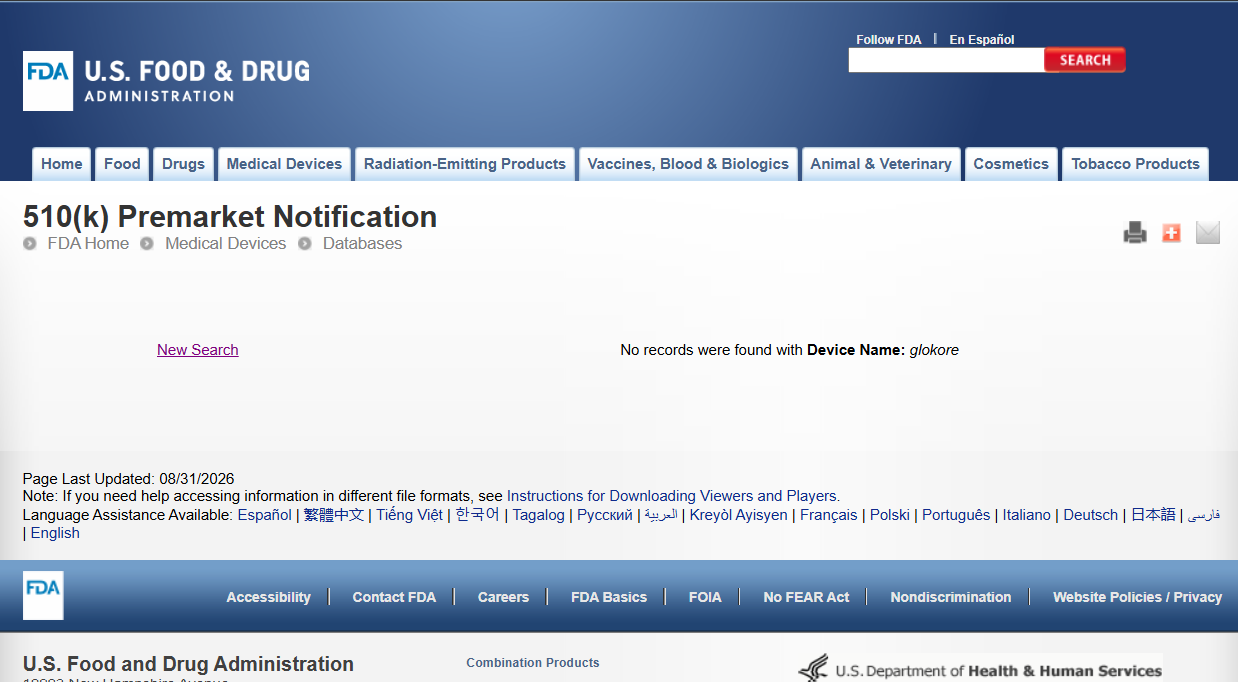
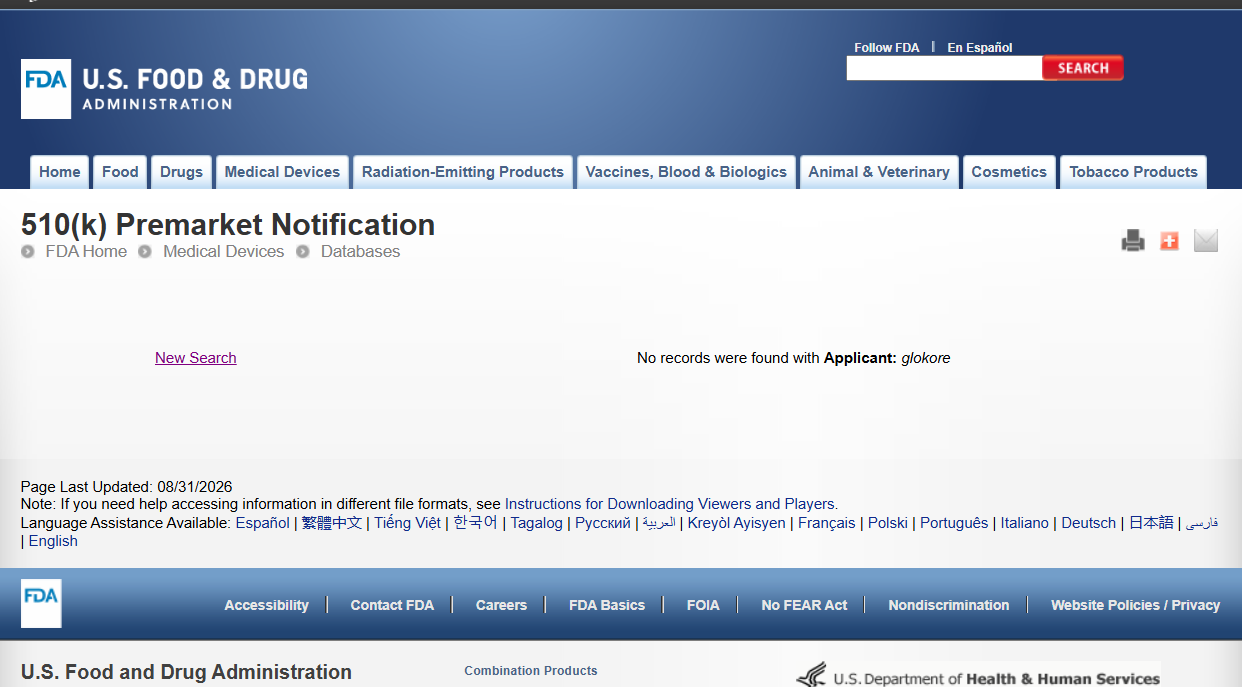
That last search is the useful one, because it shows the database is working and that this device category is well represented in it.
Why a nil result is not the whole answer
Most LED masks are built by contract manufacturers and sold under many different brand names. The clearance is held by the factory, not the brand, so a device can be legitimately covered by a clearance while the brand’s own name appears nowhere in the database. Of the 46 clearances currently on file, the large majority are registered to manufacturers rather than to consumer brands — a pattern set out in full in the list of FDA cleared LED face masks.
A worked example: how a real clearance hides behind a different name
Omnilux illustrates the pattern precisely, and following it through shows what verification actually looks like.
The Omnilux Contour Face is widely described as FDA cleared under K191629. Entering that number in the 510(k) database returns a genuine record — but the device name on it is faceLITE, and the applicant is iSMART Marketing Svcs Ltd of Sutton Coldfield, England. The word Omnilux does not appear anywhere on the record.[4]
At that point a reader could reasonably conclude the claim was false. It is not. The link is established in a second FDA database, the Global Unique Device Identification Database, which carries a record for Omnilux Contour FACE, model TN19G, listed by I-SMART DEVELOPMENTS LIMITED, with its premarket submission number given as K191629.[5]
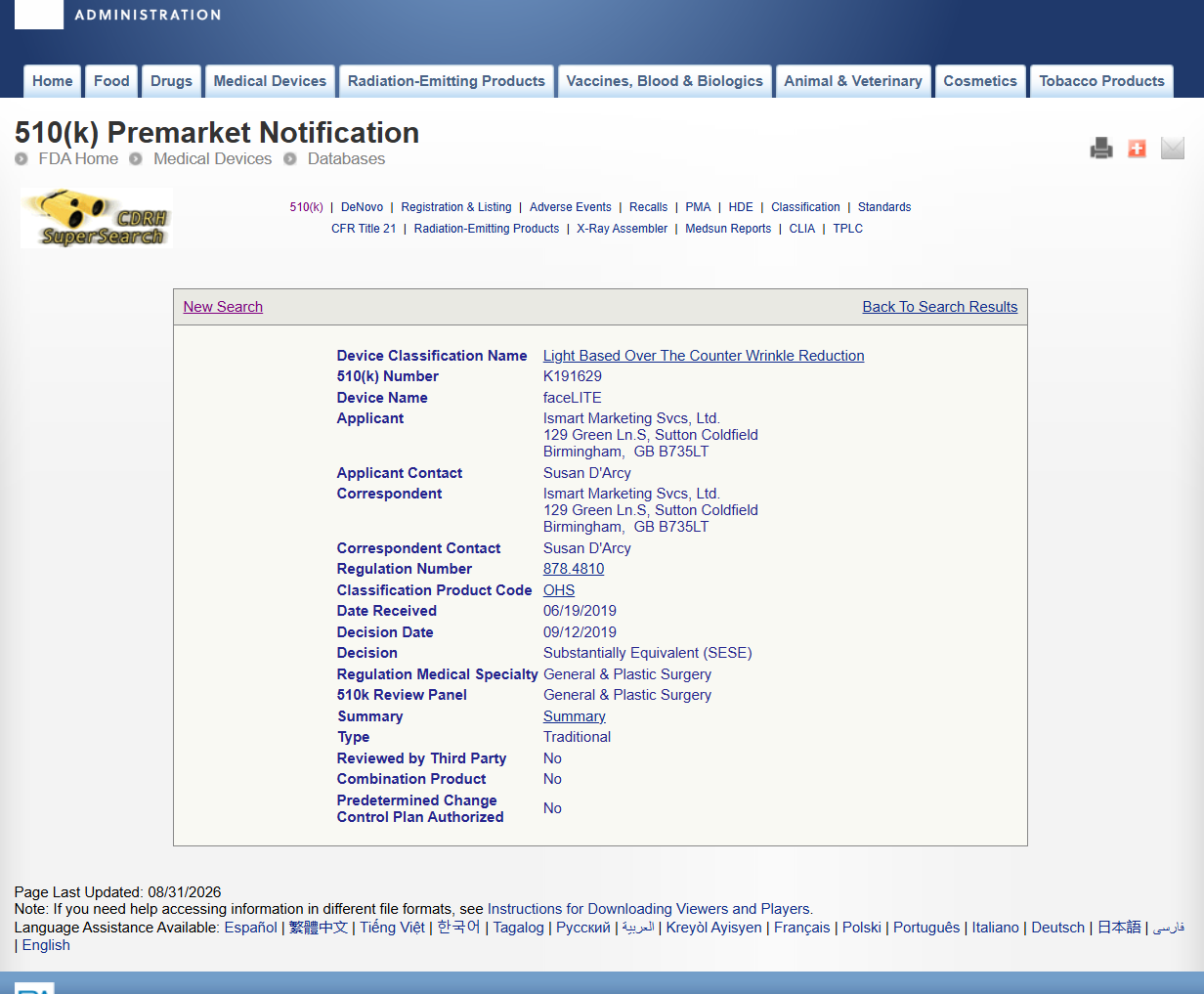
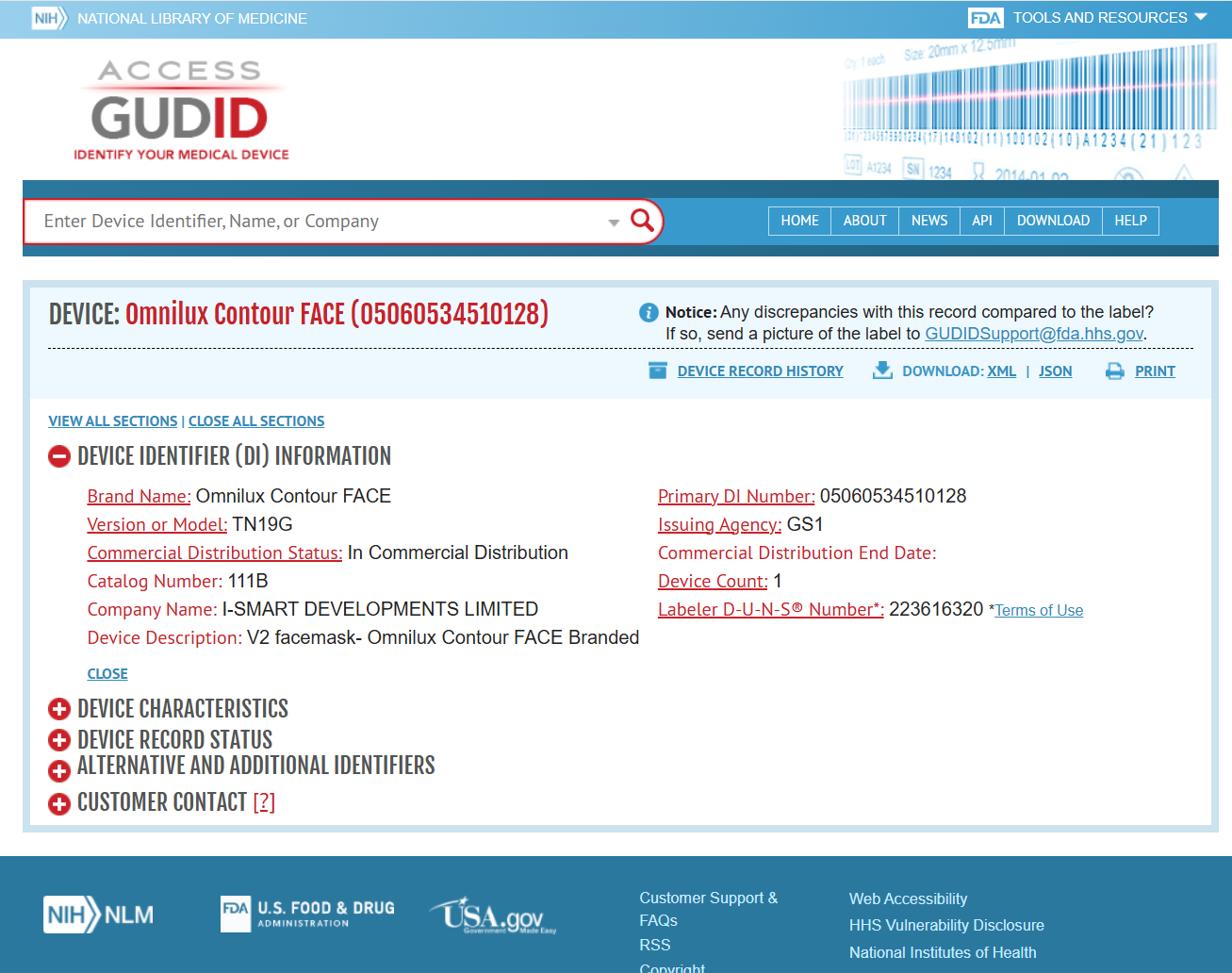
So the chain resolves: the brand on the box is Omnilux, the device name on the clearance is faceLITE, the company is the same, and both records carry the same product code (OHS, “Light Based Over The Counter Wrinkle Reduction”). The clearance is real and it covers the device. It simply cannot be found by searching the brand name.
FDA registration listings under that clearance name several consumer brands, including faceLITE, Omnilux Contour, Light Salon Boost and CurrentBody Skin — one clearance sitting behind products sold under different names, at different prices, by different companies.
This is the reason a nil database result proves nothing on its own — and equally the reason a brand that publishes its K-number is doing something meaningful. Omnilux’s clearance took three lookups to confirm. Glokore’s cannot be confirmed at all, because there is no number to start from.
The devices that do publish both numbers are set out in FDA red light therapy mask: the three that verify.
So the finding here is narrower than “Glokore is uncleared”, and more useful:
Glokore may well be selling a device covered by some manufacturer’s clearance. But because the brand publishes no K-number, there is no way for a buyer to find out which one — while competitors publish theirs and can be checked in under two minutes.
The claim is not necessarily false. It is unverifiable, and it has been made unverifiable by a choice the brand made.
The specifications, examined
Two-inch penetration depth
Two inches is roughly 50 millimetres. Light at these wavelengths does not travel anywhere near that far into tissue. Visible red light around 630 nm reaches on the order of one to three millimetres; blue at 470 nm reaches less than a millimetre; near-infrared in the 830–850 nm range penetrates furthest and still measures in single-digit millimetres.
A figure of 50 mm describes light passing through the full thickness of the face. It is not a rounding error or a marketing simplification — it is off by more than an order of magnitude, and it indicates that the specification sheet was not written by anyone checking the optics.
“Purple Light (600 nm)”
Two separate problems sit in one line. Light at 600 nm is orange; violet occupies the short end of the visible spectrum, roughly 400–450 nm. And the same description says the mode combines red and blue benefits, which would make it a blend of two emitters rather than a single wavelength. A blended mode cannot be assigned one nanometre figure.
The full set of modes found on consumer masks, and which of them correspond to a wavelength band in the published literature, is set out in the 7 color LED light therapy chart.
“Medical-grade” LEDs, and the count
“Medical-grade” has no regulatory definition. It appears constantly in this category and carries no verifiable meaning.
The count is the more informative number. Ninety LEDs is low: the Omnilux Contour Face uses 132 and the CurrentBody Series 2 uses 236. Count alone does not determine output — spacing and per-diode power matter more — but a low count with no published irradiance leaves nothing to assess.
EMF shielding
An LED mask runs on low-voltage direct current from a small battery. Electromagnetic fields are not a recognised concern for this class of device. The claim borrows a worry from an unrelated product category, and is best read as marketing rather than engineering.
CE and RoHS
RoHS restricts hazardous substances such as lead and mercury in electronics. CE marking for this class of product is frequently self-declared by the manufacturer. Both are real things a product can hold. Neither is a statement about whether the device produces a cosmetic effect, and neither is equivalent to FDA clearance.
What holds up
Red at 630 nm and blue at 470 nm are the two wavelengths with the most substantial research behind them — red for collagen support, blue for acne-associated bacteria. Green at 520 nm and yellow at 590 nm are labelled with plausible figures, though the evidence supporting them is thinner. The physical build described — flexible silicone, 290 g, auto shut-off, rechargeable — is unremarkable in a good way.
The number that is missing
Everything above is secondary to a single omission. Glokore does not publish an irradiance figure, and without one the recommended protocol cannot be evaluated.
The biological effect of low-level light therapy is described in terms of delivered dose, measured in joules per square centimetre:
Dose (J/cm²) = Irradiance (mW/cm²) × Time (s) ÷ 1000
Published research on skin rejuvenation generally places useful doses in the range of roughly five to fifteen joules per square centimetre per session. Working backwards from that, a ten-minute session needs an irradiance somewhere around 8 to 25 mW/cm² to land in range.
An instruction to use a mask for “10 to 20 minutes, three to four times a week” therefore carries no information on its own. At 30 mW/cm², ten minutes delivers about 18 J/cm². At 3 mW/cm², the same ten minutes delivers under 2 J/cm² — below the threshold at which anything is expected to happen. Both devices would carry the same instruction on the box.
This is why irradiance is the question to ask any brand in this category, ahead of LED count, ahead of the number of colour modes, and ahead of the FDA line. It is the number that determines whether the device does anything at all.
Two masks that publish what Glokore does not
Both of the following publish an irradiance figure and a clearance number. Both can be verified against the FDA database in about two minutes using the procedure set out here.
| Glokore LED Mask | Omnilux Contour Face | CurrentBody Series 2 | |
|---|---|---|---|
| FDA clearance | None published | K191629listed as faceLITE | K260715The Beauty Tech Group |
| Irradiance | Not published | ≈26–30 mW/cm² | 30 mW/cm² (stated) |
| Wavelengths | 630, 470, 520, 590 nm + blended modes | 633 nm red, 830 nm NIR | 633 nm red, 830 nm NIR, 1072 nm deep NIR |
| Near-infrared | No | Yes | Yes |
| LED count | 90 | 132 | 236 |
| Session | 10–20 min, 3–4×/week | 10 min, 3–5×/week | 10 min, 3–5×/week |
| Blue light for acne | Yes (470 nm) | No | No |
| Approx. price | Varies by seller | $395 | $469.99 |
| Omnilux site | CurrentBody site |
Prices change frequently; check the retailer for current figures. Clearance numbers verified in the FDA 510(k) database and, for Omnilux, cross-checked in GUDID.
One caveat on published figures
A published irradiance figure is a manufacturer’s claim, not an independent measurement, and independent testing does not always agree with it. One reviewer using a spectrometer measured the CurrentBody Series 2 at 18.5 mW/cm² against the stated 30, and still found the ten-minute session delivered a dose in the effective range.[3]
That gap is worth knowing about. It does not undo the distinction that matters here: a published figure can be measured, disputed and corrected. An unpublished one cannot be checked at all.
Which of the two
Omnilux is the cheaper of the pair and has the longer clinical record behind its two wavelengths. CurrentBody adds a third wavelength at 1072 nm and substantially more diodes, for about $75 more.
Neither includes blue light, so neither targets active acne. If blue is the reason for considering Glokore in the first place, a dedicated blue-light device is a better answer than a seven-colour mask with unpublished output.
Who this mask is for
Reasonable to buy if: an inexpensive multi-colour device is wanted, the budget rules out the $400 tier, and expectations are set accordingly. The wavelengths are real, the build is unremarkable, and there is a money-back window.
Not the right purchase if: the goal is a verified therapeutic dose, or if the decision was influenced by an FDA claim attached to the listing. That claim is the weakest part of it, and it is the part most likely to have persuaded someone.
Before buying anything in this category, ask the seller two questions: which K-number covers this device, and what is the irradiance in mW/cm². Brands with good answers give them immediately. The answers, or their absence, tell you more than any review.
Frequently asked questions
Is Glokore a real company?
Glokore operates a storefront and ships product, and the mask is sold through more than one retailer. What cannot be established from public records is which manufacturer builds the device or which regulatory clearance, if any, covers it. The brand’s own site does not appear at the top of search results for its own name, which is unusual for an established company and more typical of a paid-advertising storefront.
Is the Glokore LED mask FDA approved?
No, and no LED face mask is — approval applies to Class III devices such as pacemakers. Class II devices like this one are cleared, not approved, and clearance produces a K-number that anyone can look up. A search of the FDA database on 29 August 2026 returned no clearance under the Glokore name, and no K-number is published for buyers to check, so any FDA claim attached to this mask cannot be verified.
Does that mean the mask is dangerous?
Nothing here suggests a safety problem. LED masks in this category emit no UV and generate little heat. The concern is efficacy and accuracy of claims, not harm — the device may simply deliver too little light to do anything.
Why does irradiance matter more than the number of LEDs?
Because dose is what produces an effect, and dose is irradiance multiplied by time. A mask with many diodes and low output can deliver less light than one with fewer, brighter diodes. LED count is visible on a product photo; irradiance is not, which is part of why it is advertised less often.
Are the seven colour modes useful?
Red and blue have the strongest research behind them. Green and yellow have some support. The blended modes — described as purple and cyan — are two sets of diodes running at once rather than distinct wavelengths, and the single nanometre figure quoted for the purple mode does not correspond to purple light.
What should I ask a seller before buying any LED mask?
Two questions. Which 510(k) clearance number covers this device, and what is the irradiance in mW/cm² at the treatment surface. Both answers are checkable, and a brand that will not supply them has decided that its claims should not be checked.
References
- U.S. Food and Drug Administration. Premarket Notification 510(k).
- U.S. Food and Drug Administration. Device Registration and Listing.
- Light Therapy Insiders. CurrentBody Series 2 mask review — independent spectrometer measurement.
- U.S. Food and Drug Administration. 510(k) record K191629 — faceLITE, iSMART Marketing Svcs Ltd. Decision date 12 September 2019.
- National Library of Medicine / FDA. GUDID record for Omnilux Contour FACE (DI 05060534510128), premarket submission K191629.
- U.S. Food and Drug Administration. 510(k) Premarket Notification Database. Searched 29 August 2026.
How this Glokore LED mask review was done
This review is based on searches of the FDA 510(k) and GUDID databases carried out on 29 August 2026, screenshots of which appear above; on the specifications published for this mask across its retail listings; and on specifications published by the comparison brands. The device was not tested on skin. No claim is made here about the wording of any particular seller’s page, which can change without notice. Where a figure is a manufacturer’s claim rather than an independent measurement, it is described as such.