Most INIA red light mask reviews describe how the device feels and what the reviewer’s skin looked like afterwards. This one checks the two things a buyer cannot assess by wearing it: whether an FDA clearance exists, and whether the published output figure makes sense against the doses used in research.
INIA does something most brands in this category do not — it publishes an irradiance figure. That is the single most useful number a mask manufacturer can disclose, and it deserves credit. It also raises a question the product page does not answer, because the figure is unusually high and no measuring distance is given alongside it.
Verdict at a glance
| FDA clearance | Partly traceable Two clearances list model numbers beginning INIA, held by a Chinese manufacturer. Whether they cover the GLOW Wireless cannot be confirmed, because INIA publishes no K-number. |
| Irradiance | Published 105 mW/cm² — rare disclosure and the right number to give. No measuring distance is stated, which is what would make it checkable. |
| Session length | Needs care At 105 mW/cm², research-range doses are reached in roughly one to one and a half minutes. Longer is not better. |
| Wavelengths | Sound 630 nm red, 460 nm blue and 850 nm near-infrared are all well-represented bands. Including near-infrared puts this ahead of most seven-colour masks. |
| One labelling error | Minor The 610 nm mode is described as yellow. 610 nm is orange; yellow sits at 570–590 nm. |
| Bottom line | Better specified than most masks at this price, with a real gap the brand could close in one sentence by publishing its K-number and the distance at which 105 mW/cm² was measured. |
Contents
What INIA publishes
Taken from the INIA GLOW Wireless product page, captured 8 September 2026. These are the manufacturer’s figures, not measurements taken here.
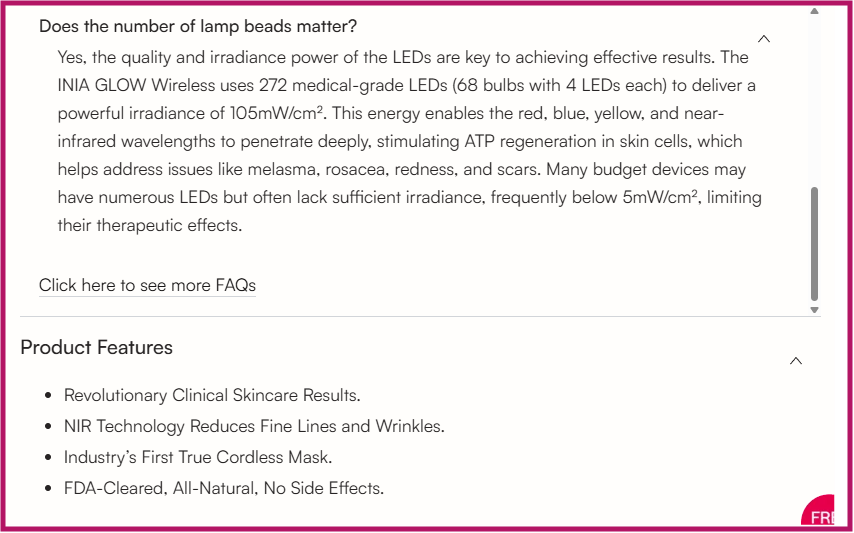
- 272 LEDs — described as 68 bulbs with four LEDs each
- Irradiance 105 mW/cm²
- Wavelengths — red 630 nm, blue 460 nm, yellow 610 nm, near-infrared 850 nm
- Price — $299.99 list, discounted to $119.99, $99.99 with a coupon
- 90-day money-back guarantee, two-year warranty
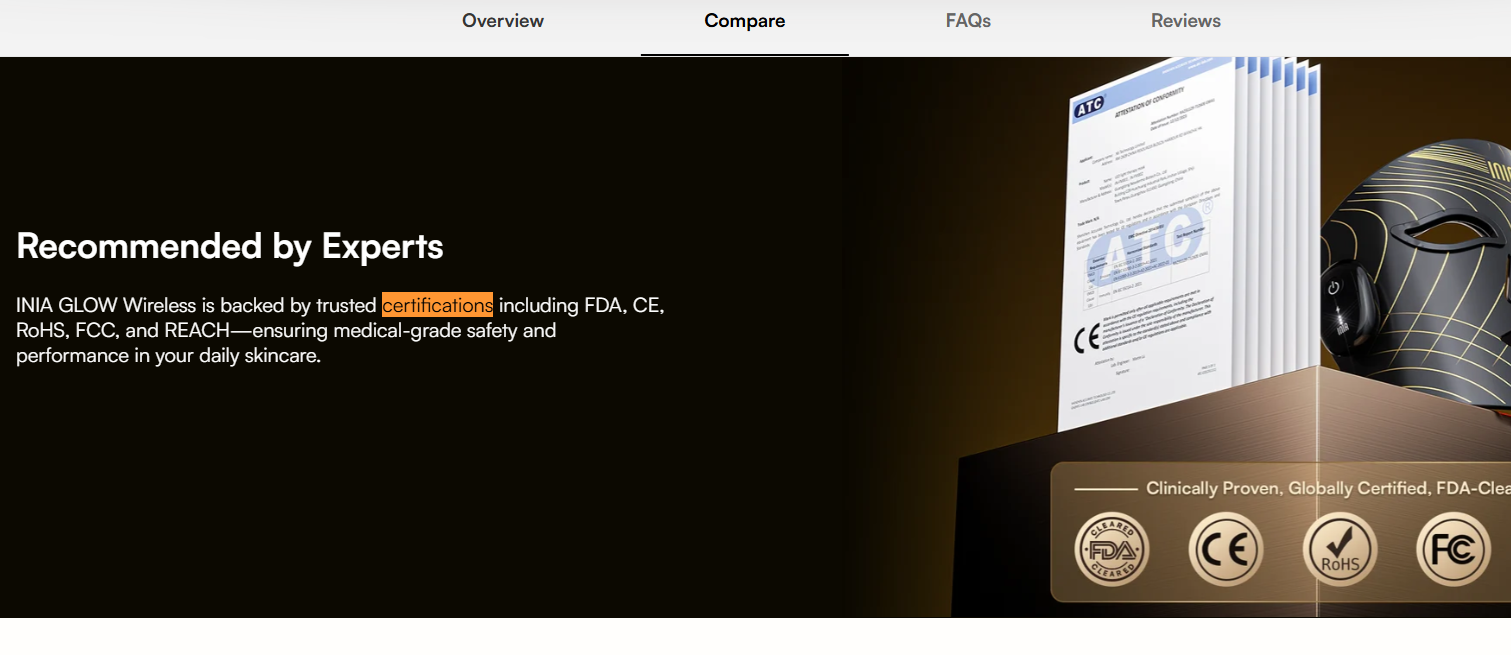
- Certifications given as FDA, CE, RoHS, FCC and REACH
The specification page also makes a comparative claim worth quoting, because it is the same argument this site has been making: that many budget devices carry a large number of LEDs but deliver irradiance below 5 mW/cm², which limits their therapeutic effect. That is correct, and it is unusual to see a brand say it.
The FDA search, and what it returned
INIA lists FDA among its certifications, alongside CE, RoHS, FCC and REACH. The FDA does not certify devices; it clears them, and clearance produces a number. So the question is whether a number exists.
Searching the applicant name
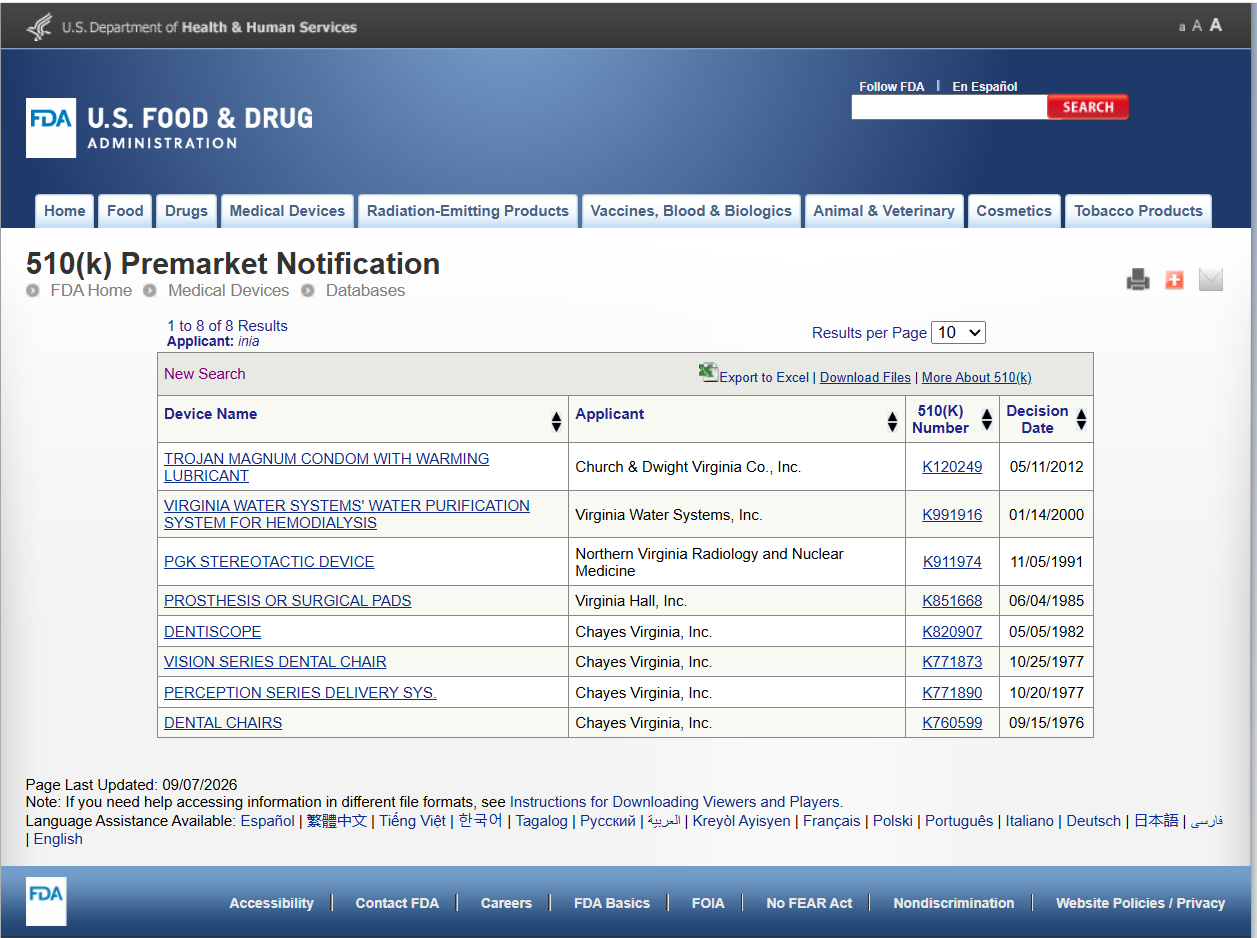
Searching the FDA 510(k) database for an applicant named INIA returns eight records, none of them relevant: a condom, a hemodialysis water purification system, a stereotactic device, surgical pads and three dental products, filed between 1976 and 2012.
The reason is worth understanding, because it affects every search anyone runs in this database. The applicants are companies in Virginia — Virginia Water Systems, Chayes Virginia, Virginia Hall. The database matches substrings, and the letters inia sit inside Virg-inia. A search can return eight results and still mean nothing.
Searching the device name
Searching the device name field returns 66 records, most of them the same kind of artefact — TMINI Miniature Robotic System, Trinias, Freedom Infinia Total Knee System. Two are not artefacts:
| 510(k) | Device | Applicant | Cleared |
|---|---|---|---|
| K253833 | Facial & Body Beauty Device — models include INIA-BD001 to INIA-BD004, INIA-ED001, INIA-ED002, INIA-BLD001 | Shenzhen Jianchao Intelligent Technology Co., Ltd. | 30 Jan 2026 |
| K252553 | Facial & Body Beauty Device — same INIA-prefixed model range | Shenzhen Jianchao Intelligent Technology Co., Ltd. | 09 Oct 2025 |
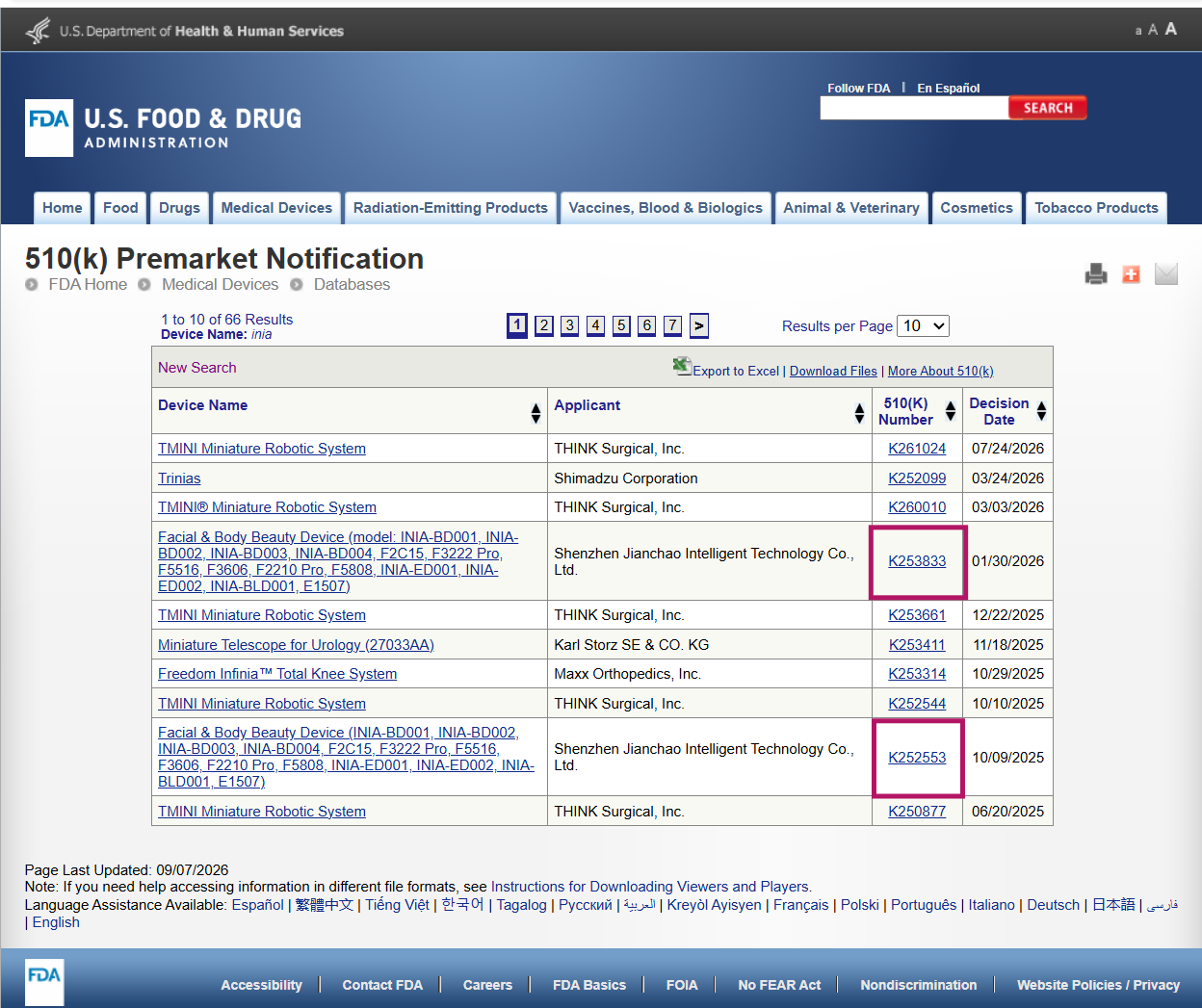
These are real clearances covering devices whose model numbers begin with INIA, held by a Chinese contract manufacturer. That is a materially different result from finding nothing.
What can and cannot be concluded
The pattern matches the way this industry works: clearances are held by the factory, and the brand on the box appears nowhere on the record. The list of FDA cleared LED face masks sets out how common that is.
What is missing is one link in the chain. The clearances cover a specific list of model codes. INIA does not publish which model code the GLOW Wireless carries, and does not publish a K-number. So a buyer can see that an INIA-branded product line is cleared, without being able to establish that this mask is one of them.
This is a smaller gap than most brands leave, and an easier one to close. One line on the product page — the model code, or the K-number — would make the claim fully checkable. Until then, “FDA” in a list of certifications is doing more work than the record supports.
For contrast, Omnilux publishes its clearance and the chain resolves in three lookups, as set out in the Glokore LED mask review. Glokore, at the other end, publishes nothing and returns nothing.
105 mW/cm², and what it implies
Publishing an irradiance figure is the right thing to do and most brands do not. It is also the number that determines whether a session does anything, because delivered dose is irradiance multiplied by time:
Dose (J/cm²) = Irradiance (mW/cm²) × Time (s) ÷ 1000
Published work on skin and cosmetic outcomes places the useful per-session dose at roughly 5 to 9 J/cm², with a broader effective window of about 3 to 15 J/cm².[1] Light therapy follows a biphasic dose response: too little does nothing, and beyond a point more delivers no additional benefit.
Applying the arithmetic to a stated 105 mW/cm²:
| Session length | Delivered dose | |
|---|---|---|
| 60 seconds | 6.3 J/cm² | within range |
| 90 seconds | 9.4 J/cm² | upper end |
| 3 minutes | 18.9 J/cm² | above the window |
| 10 minutes | 63 J/cm² | far above |
At this irradiance a research-range dose arrives in roughly 48 to 86 seconds. A ten-minute session — the standard length for masks in the 26 to 30 mW/cm² range — would deliver about seven times the upper end of the effective window.
Two readings, and why the distance matters
There are two ways to read this, and the product page does not settle which is correct.
The figure is measured at the LED surface. Irradiance falls off with distance, and a mask sits some millimetres off the skin. A figure taken at the diode face can be several times the figure at the treatment surface. This is a common measuring convention and it is not dishonest — but without a stated distance, the number cannot be compared with a competitor’s.
The figure is accurate at the skin. In that case the mask is genuinely powerful, and session length becomes the thing to get right rather than an afterthought. Short sessions would be a feature, not a compromise.
Either way, the practical guidance is the same: follow the manual’s stated session length rather than assuming longer is better. Independent testing of published irradiance figures has found gaps between claim and measurement in this category before, in both directions.[2]
The full working, with a calculator for any device, is in how long to do red light therapy on face.
The wavelengths
Three of the four are well chosen, and the selection is more defensible than a seven-colour chart.
- Red, 630 nm — the most studied band for cosmetic use, associated with collagen synthesis and skin rejuvenation.
- Blue, 460 nm — the acne band, working through an antibacterial mechanism.
- Why both matter — the two bands treat different layers and different problems, compared in red vs blue light therapy.
- Near-infrared, 850 nm — invisible, penetrates furthest, and well represented in research on wound healing and skin aging. Its inclusion is the most meaningful specification on the list, because it is the band budget masks leave out precisely because buyers cannot see it working.
- 610 nm, described as yellow — 610 nm is orange. Yellow occupies roughly 570 to 590 nm. The band studied for melasma and photoaging is the yellow one, so the label and the figure point at slightly different things.
The 610 nm discrepancy is minor next to the errors common in this category — it is 20 nanometres off, not a claim that light travels two inches through skin. But it is the kind of detail that separates a specification written by someone measuring from one assembled from a supplier’s datasheet. The full breakdown of which modes correspond to a researched band appears in the 7 color LED light therapy chart.
What the research actually supports for the shorter wavelengths, including the 610 nm band and green, is covered in what does green light therapy do.
How it compares
| INIA GLOW Wireless | Omnilux Contour Face | CurrentBody Series 2 | |
|---|---|---|---|
| FDA clearance | Model line clearedK-number not published | K191629listed as faceLITE | K260715The Beauty Tech Group |
| Irradiance | 105 mW/cm²no distance stated | ≈26–30 mW/cm² | 30 mW/cm² (stated) |
| Wavelengths | 630, 460, 610, 850 nm | 633 nm red, 830 nm NIR | 633, 830, 1072 nm |
| Near-infrared | Yes | Yes | Yes |
| Blue for acne | Yes (460 nm) | No | No |
| LED count | 272 | 132 | 236 |
| Approx. price | $99–120list $299.99 | $395 | $469.99 |
| INIA site | Omnilux site | CurrentBody site |
Prices change frequently and INIA’s list price is heavily discounted at time of writing; check the retailer for current figures. Clearance numbers verified in the FDA 510(k) database.
On specification, INIA covers more wavelength bands than either premium option, at roughly a quarter of the price, and it is the only one of the three offering blue light for acne. What it does not offer is a verifiable clearance for the specific device, or an irradiance figure stated in comparable terms.
Who this mask suits
A reasonable purchase if: the budget rules out the $400 tier, both red and blue are wanted, and near-infrared matters. On paper it is better specified than most masks selling for the same money, and the wavelength selection reflects the research rather than the marketing.
Look elsewhere if: a fully documented clearance is the deciding factor. Omnilux and CurrentBody both publish a K-number that resolves to their device. INIA does not, and that is a real difference even though the underlying situation may be entirely legitimate.
Whichever is chosen, two questions do most of the work: which K-number covers this device, and at what distance was the irradiance measured. INIA answers the second better than almost anyone and the first not at all. Most of the category answers neither.
The full comparison of devices that answer both is in FDA red light therapy mask: the three that verify.
Frequently asked questions
Is the INIA red light mask FDA cleared?
Partly. Two FDA clearances, K253833 and K252553, cover a Facial and Body Beauty Device whose listed model numbers begin with INIA, held by Shenzhen Jianchao Intelligent Technology. INIA does not publish a K-number or the model code of the GLOW Wireless, so a buyer cannot confirm that this specific mask is among the models covered. That is a smaller gap than most brands leave, and one the company could close with a single line on the product page.
Is 105 mW/cm² a good irradiance for a face mask?
It is high. Premium masks typically publish figures around 26 to 30 mW/cm². Publishing any figure at all is unusual and worth credit, but the number is only comparable if the measuring distance is stated, and INIA does not give one. Irradiance measured at the LED surface can be several times the figure at the skin, which is where it matters.
How long should an INIA mask session be?
Follow the manual rather than assuming longer is better. At a stated 105 mW/cm², a research-range dose of 5 to 9 J/cm² arrives in roughly 48 to 86 seconds. A ten-minute session at that irradiance would deliver about 63 J/cm², well beyond the effective window. Light therapy has a biphasic dose response: too little does nothing, and past a point more adds nothing further.
What wavelengths does the INIA GLOW Wireless use?
Red at 630 nm, blue at 460 nm, near-infrared at 850 nm, and a fourth mode given as 610 nm. The first three are well-represented bands in the research, and including near-infrared is a meaningful choice because it is invisible and budget masks routinely omit it. The 610 nm mode is described as yellow, but 610 nm is orange; yellow sits at roughly 570 to 590 nm.
Why did searching the FDA database for INIA return dental chairs?
Because the database matches substrings. The letters “inia” appear inside “Virginia”, so an applicant search returns companies such as Virginia Water Systems and Chayes Virginia, with filings going back to 1976. Eight results that look like a hit are worth nothing until the applicant and device names are read. Searching the device name field instead surfaced the two clearances that are genuinely relevant.
Is the INIA mask worth it compared to Omnilux or CurrentBody?
On specification it covers more wavelength bands than either, including blue light for acne, at roughly a quarter of the price. What it does not offer is a clearance number that resolves to this specific device, or an irradiance figure stated at a comparable distance. If documentation is the deciding factor, Omnilux and CurrentBody both publish a K-number that can be checked in two minutes.
References
- Light Therapy Insiders. Light therapy mask dosing guide — per-session fluence ranges and worked dose calculations.
- Light Therapy Insiders. CurrentBody Series 2 review — independent spectrometer measurement against a published figure.
- U.S. Food and Drug Administration. 510(k) Premarket Notification Database. Searched 8 September 2026.
- U.S. Food and Drug Administration. Premarket Notification 510(k).
How this INIA red light mask review was done
Specifications are taken from the INIA GLOW Wireless product page as published on 8 September 2026, and are the manufacturer’s figures rather than measurements taken here. FDA records were retrieved from the 510(k) database on the same date, searching both the applicant name and device name fields; screenshots of both searches appear above. Dose calculations apply the standard fluence formula to the manufacturer’s stated irradiance and are arithmetic, not measurement. The device was not tested on skin, and no claim is made about results. Prices are as displayed at time of writing and change frequently.